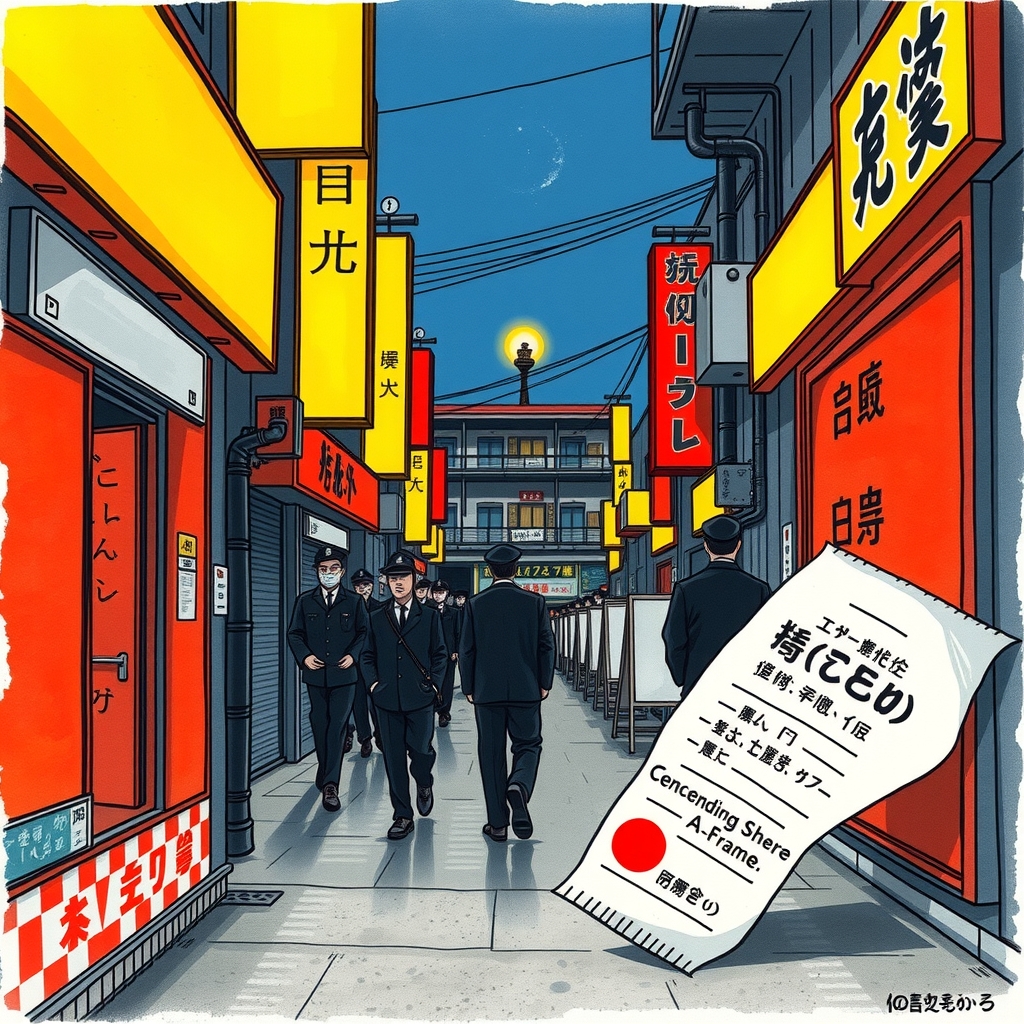
Nine Orders and Forty Signs
At around 7 p.m. on August 25, 2026, roughly a hundred police officers and Nagoya city employees assembled on the streets of Naka Ward and walked into Nishiki 3-chome — the block Nagoya calls Kin-san, the largest nightlife district in central Japan.
They came out with nine orders and forty signs.
Nine people, men and women, were served recurrence-prevention orders (saihatsu boshi meirei) for kyakumachi koi — loitering in a public place in order to solicit customers — according to Tokai Television and TV Aichi. City officials had restaurant and bar operators remove 40 sidewalk signs placed on public roadway without permission, Chukyo Television reported. Enforcement against illegal parking continued into the early hours of August 26, per CBC Television.
Nobody was arrested.
That is the point of the operation, and also the measure of it. Aichi Prefectural Police call this the Sakae District Purification Operation (Sakae chiku joka sakusen), and say the August 25 outing was the largest in its scale to date. Outlets differed on the headcount: Tokai Television put the deployment at about 110 people, Chukyo Television at about 80 police and municipal staff, and CBC Television described roughly 70 police officers working the Kin-san sweep itself.
The deadline is on the calendar. The 20th Asian Games open in Aichi on September 19 and run through October 4, with competition in some sports beginning about nine days before the opening ceremony. The Asian Para Games follow from October 18 to 24.
"With the Asian Games and Asian Para Games ahead of us, we expect an increase in visitors from inside and outside Japan," a superintendent named Matsui of the Aichi Prefectural Police public safety division told reporters, in a quote carried by CBC and Chukyo Television. "We want to aim for an entertainment district where those people can spend their time with peace of mind."
What a Tout Is Selling
The word "touting" undersells what is being regulated here.
Under the Aichi Prefecture Nuisance Prevention Ordinance (Aichi-ken meiwaku koi boshi jorei), the prohibited conduct is not merely handing out flyers. The ordinance's touting provision covers soliciting passersby, by calling out or distributing leaflets, for sexual services or businesses that imitate them, and for food-and-drink establishments that trade on an entertainment atmosphere — the hostess clubs, girls bars and sekukyaba that fill the Kin-san blocks. A separate clause bans kyakumachi: standing in a publicly visible way, in zones designated by Public Safety Commission rule, waiting for someone to approach. Parts of Naka Ward in Nagoya sit inside those zones. That clause is what the nine were served under.
The penalty structure explains why a sweep produces orders rather than handcuffs. Touting itself carries a fine of up to ¥1 million, rising to up to six months' confinement for habitual offenders — but proving a specific solicitation of a specific person, in a crowd, at night, is slow work. The order route is fast. An officer on the scene can direct a person to stop, and that instruction runs until 6 a.m. the following morning; where police believe the conduct will be repeated, the Public Safety Commission can issue an order lasting up to six months. Breaking either one is itself an offense, punishable by a fine in the low hundreds of thousands of yen. Reports on the August 25 sweep did not specify which tier the nine received.
In practice the order is a paper trail. The first one costs a tout nothing. The second one is a crime.
The Bill at the End of the Sidewalk
The reason Nagoya cares about men standing on a corner is what happens two hundred meters later.
Aichi Prefectural Police received 263 consultations about overcharging — bottakuri — in 2025, TV Aichi reported. The pattern police describe is consistent: a drunk customer is picked up by a tout, walked to a bar, and presented at the end of the night with a bill inflated by drinks bought for the women sitting with him.
"There are many cases where someone is drawn in by a tout while intoxicated and then billed a high amount, including the cost of the female staff's drinks," a police official told TV Aichi.
The approach is soft. A TV Aichi reporter walking Nishiki 3-chome was approached by eight touts in ten minutes. One pitch, as broadcast: "Just keep us company for one drink. Won't you at least take a look? Looking is free." A man in his fifties who lives nearby told the station the touts feel "really frightening," and that walking through the area makes him uneasy.
The numbers behind the campaign are worse than the 2025 total suggests. The Chunichi Shimbun reported in December 2025 that police had taken 240 complaints from customers of 61 separate establishments through the end of November. Tokai Television, reporting the same month, put the number of touts working Sakae at roughly 220, and said bottakuri losses in the district were approaching ¥150 million by the end of November. The station also described a trend police had been tracking for about two years: minors doing the touting. Since September 2025, when the Sakae campaign began, police had arrested eight people over having under-18s solicit customers late at night — including, the station said, a 15-year-old who had stopped attending high school.
The Enforcement Ladder
The August 25 sweep is the administrative rung of a ladder Nagoya has been climbing all year.
On July 29, 2026, Aichi police raided an unlicensed host club in Sakae. On August 20, they announced the arrest of a 28-year-old hostess-club owner and a 25-year-old employee accused of holding a customer's driver's license as collateral and making him write down his employer's name and a parent's phone number to secure payment of a ¥381,000 balance; police said 11 people had complained about that one club since January, with losses near ¥5.6 million.
Arrests reach individual operators. Sweeps reach the sidewalk. Neither reaches the economics, which is why the touts were back the following night, and why police say enforcement will be sustained through the Games rather than concentrated in them.
There is a version of this story that treats the operation as theater staged for an international audience — a hundred officers moving nine people along, four weeks before the cameras arrive. That reading is available. But the ordinance being enforced is not new, the campaign predates the Games by a year, and the complaint volume underneath it is real and rising. What the Games supplied was a deadline.
| Detail | As reported |
|---|---|
| Date | Night of August 25, 2026, from about 7 p.m.; parking enforcement into the early hours of August 26 |
| Location | Nishiki 3-chome ("Kin-san"), Naka Ward, Nagoya |
| Agencies | Aichi Prefectural Police (public safety division) and the City of Nagoya |
| Deployment | About 110 people (Tokai TV); about 80 police and city staff (Chukyo TV); about 70 officers (CBC) |
| Result | Recurrence-prevention orders to 9 people for loitering to solicit; 40 illegal sidewalk signs removed |
| Arrests | None reported |
| Legal basis | Aichi Prefecture Nuisance Prevention Ordinance — touting and customer-waiting provisions |
| Penalties | Touting: fine up to ¥1 million, or up to 6 months' confinement if habitual. Violating an order: fine in the low hundreds of thousands of yen |
| Context | 263 overcharging complaints in 2025; about 220 touts counted in Sakae as of December 2025; losses near ¥150 million through November 2025 |
| Deadline | Asian Games, September 19 – October 4, 2026; Asian Para Games, October 18–24, 2026 |
Sources
Reporting by Tokai Television, CBC Television, Chukyo Television, TV Aichi and NHK, all published August 26, 2026, on the August 25 operation; background figures from Chunichi Shimbun (December 28, 2025) and Tokai Television (December 17, 2025). Games dates per the Aichi-Nagoya 2026 competition schedule. Legal provisions summarized from the text of the Aichi Prefecture Nuisance Prevention Ordinance. This account reflects administrative actions and allegations as described by police and the outlets above; no one involved in the August 25 operation has been charged with a crime.