A Case That Cannot Be Tried
On September 1, 2026, the Hyogo police station of the Hyogo Prefectural Police referred a file to the Kobe District Public Prosecutors Office naming Tsubosaka Ryo, 33, self-employed, of Osaka's Ikuno Ward, as a suspect in murder. Tsubosaka has been dead since June.
The referral is what Japanese police call higisha shibō no mama shorui sōken — sending the papers with the suspect deceased. Prosecution ends at death; the prosecutors office will record a non-prosecution disposition on the ground that the suspect has died. No trial will follow, no evidence will be tested by a defense, and no court will rule on what happened in that room.
Police refer these files anyway. The alternative is leaving a homicide open on the books indefinitely. The referral is the state's formal statement of what it believes occurred, and it is the only such statement this case will ever get.
What police say occurred, according to reporting by Kyodo News and the Sankei Shimbun, is this. On June 28, 2026, between roughly 5:10 p.m. and 9:40 p.m., in a room at a sex establishment in Fukuhara-chō, Hyogo Ward, Kobe, Tsubosaka stabbed a 33-year-old woman who worked there repeatedly in the neck and chest with a kitchen knife, then stabbed himself in the chest. Both died of blood loss. A judicial autopsy gave hemorrhagic shock as the cause of death for each.
He had bought the knife in Kobe earlier the same day, before he arrived at the shop as a customer.
Investigators attribute the killing to romantic feelings that were not returned, and treat it as an attempt at what Japanese calls muri shinjū — a forced double suicide, one person deciding for two.
The woman has not been named in Japanese reporting. She was described as a part-time employee of the business.
Two Years of Requesting Her by Name
The detail that separates this case from a stranger attack is the length of the relationship that preceded it.
According to the Sankei, Tsubosaka had been a customer of the shop for about three years, and for roughly the last two he had been requesting the same woman each time. Police found no record of prior trouble between them — no complaint, no reported dispute, nothing the business had flagged.
Requesting a specific worker is not an incidental feature of Japan's sex industry. It is the industry's revenue architecture. Shimei — literally "naming" — is the system under which a customer books a particular woman rather than whoever is free, pays a surcharge for the privilege, and returns. A worker's earnings track her shimei count. Shops build their pricing, their rankings and their online profiles around it. Repeat custom by name is the business model working exactly as designed.
It is also, structurally, the mechanism by which a stranger becomes a fixture. Two years of appointments produce familiarity, routine, a sense on the customer's side of a relationship rather than a transaction — and, in a small number of cases, a conviction that the relationship is owed something. The industry has a term of art for the failure mode, honki koi, "falling for real." It is usually discussed as an occupational nuisance. Here it is the motive police have assigned to a homicide.
Nothing in the reporting suggests the shop had reason to see this coming. That is the uncomfortable part. The warning signs investigators later reconstructed — the accumulating visits, the exclusive requests — are indistinguishable, in real time, from a good customer.
Locked, and Past the Hour
The sequence of the discovery is documented in the June reporting by the Kobe Shimbun, Asahi Broadcasting Corporation, Sun Television, Kansai Television and the Yomiuri Shimbun, and it is the operational heart of the story.
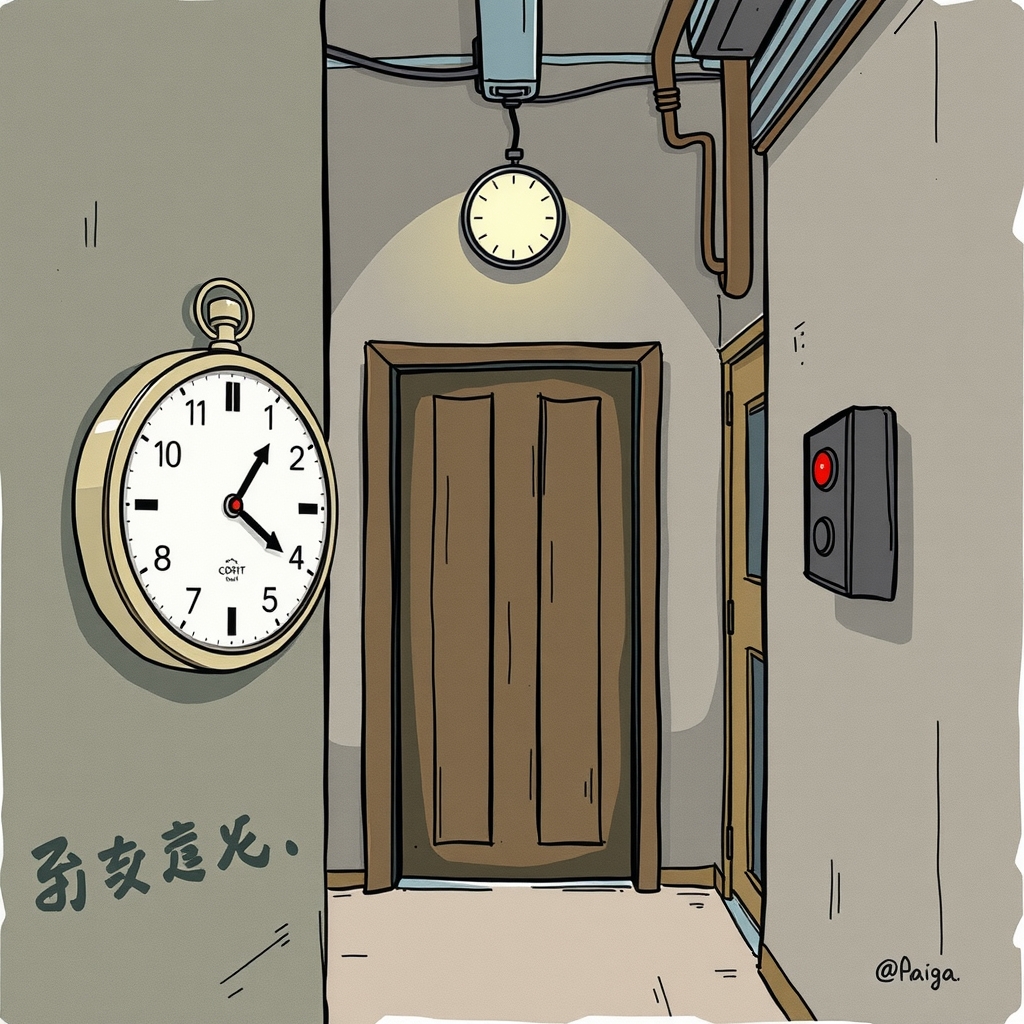
The booking ran out. The customer did not come out. Staff tried to reach the room by phone and got no answer. When an employee went to check, the door was locked. When they finally got inside, both people were on the floor, bleeding, with wounds to the upper body. A knife was in the room. The emergency call went out at about 9:55 p.m. Both were taken to a hospital and confirmed dead.
Read that against the police timeline and the gap is stark. The stabbing occurred somewhere in a window that opened at 5:10 p.m. and closed at 9:40 p.m. The alarm was raised at 9:55. The thing that eventually summoned help was not a distress signal from inside the room. It was a booking running over.
Japan's Businesses Affecting Public Morals Regulation Act — fūzoku eigyō-tō no kisei oyobi gyōmu no tekiseika-tō ni kansuru hōritsu, the fūei-hō — governs businesses of this kind through a notification regime. It regulates where they may operate, when, how they may advertise, and how they must verify that workers and customers are adults. It is a public-order statute. It does not set safety standards inside the room for the person working there, and it does not require that she have a way to call for help.
Reporting has not disclosed whether this room had an emergency button, and that absence in the coverage should be read as an absence in the coverage and nothing more.
A District Already Under Pressure
Fukuhara is Kobe's historic red-light quarter, a dense grid of soaplands in Hyogo Ward with a licensed lineage running back more than a century. In 2026 it has been under sustained police attention.
Six days before the killing, on June 22, Hyogo Prefectural Police arrested a 46-year-old company executive from Itami over a Fukuhara soapland — the third arrest in an Anti-Prostitution Act (baishun bōshi-hō) case built on the offense of providing premises for paid sex as a business. That investigation was part of a wave of soapland enforcement that has run through Yoshiwara in Tokyo, Aoba Ward in Sendai, Furumachi in Niigata and Fukuhara this year, after decades in which the same businesses operated in plain view.
The two stories are not causally linked, and nothing in the reporting connects the June 22 arrest to the June 28 deaths. But they describe the same district from opposite directions. The enforcement wave asks who is profiting from the premises. The killing asks who is protected inside them. Japanese regulation has a great deal to say about the first question and very little about the second.
The Law That Arrives Next Month
Five weeks after this referral, on October 1, 2026, Japan's amended Labor Policy Comprehensive Promotion Act (rōdō shisaku sōgō suishin-hō) makes customer-harassment countermeasures a legal obligation for employers. The amendment was promulgated on June 11, 2025; the Ministry of Health, Labour and Welfare issued its implementing guideline on February 26, 2026.
The duty is broad in one dimension and narrow in another. It binds every employer with at least one worker — no size threshold, no phase-in for small firms. Employers must set and publicize a policy, provide a consultation channel, respond after an incident, and take preventive steps, while protecting the privacy of anyone who complains and refraining from adverse treatment of them.
The narrowness is in the word worker. The obligation runs to employees. Across Japan's sex industry, the prevailing arrangement is not employment: workers are engaged under gyōmu itaku, business-consignment contracts, as nominally independent operators who rent time and space from a shop. That structure keeps labor law — and with it most of the employer duties that October 1 will impose — at arm's length from the people most exposed to the customers those duties are about.
The woman killed in Fukuhara was reported as a part-time employee. If that description is accurate in the legal sense, she sat inside the category the new law will cover. Most of her colleagues nationally do not.
The scale of the gap is visible in who is absorbing the demand instead. Fūteras, a nonprofit offering free legal and welfare consultations to sex workers, handled 4,939 consultations in 2024, its highest annual figure, and now takes more than 300 a month. Its case notes describe coerced sex, stalking and covert filming by customers. It is, functionally, the complaints channel for a workforce that does not have one.
What the Record Will Show
Prosecutors will close the file with a non-prosecution disposition. There will be no charge, no trial, no verdict, and no finding by a court — only a police conclusion, reported by two national news organizations, that a 33-year-old man bought a knife in Kobe on a June afternoon and used it on a woman who had been serving him by name for two years.
The parts of this that are ordinary are the parts worth holding onto. He was not an intruder. He had a booking. He was, by every metric the business tracks, a good customer — a regular, loyal, returning by name. The door locked because that is what the door is for. The alarm was raised because the hour ran out.
Sources: Kyodo News, "Man referred to prosecutors over suspected killing of woman, Kobe; suspect deceased, sex establishment," September 1, 2026 (carried by the Kumamoto Nichinichi Shimbun, Fukui Shimbun, Hokkaido Shimbun, Ryukyu Shimpo, Minami-Nippon Shimbun and Nishinippon Shimbun); Sankei Shimbun, "Exclusive: Man and woman dead at Hyogo Fukuhara sex establishment — man referred to prosecutors on suspicion of murder, Hyogo police station, Hyogo Prefectural Police," September 1, 2026. Details of the June 28 discovery are drawn from contemporaneous reporting by the Kobe Shimbun, Asahi Broadcasting Corporation, Sun Television, Kansai Television and the Yomiuri Shimbun. The June 22, 2026 Fukuhara arrest is as reported by the Kobe Shimbun. The customer-harassment provisions are from the amended Labor Policy Comprehensive Promotion Act (promulgated June 11, 2025; in force October 1, 2026) and the Ministry of Health, Labour and Welfare guideline of February 26, 2026. Consultation figures are published by the nonprofit Fūteras. The woman who died has not been named by Japanese media. No charge has been filed and none can be; the suspect is deceased and the allegations against him have not been tested in court.