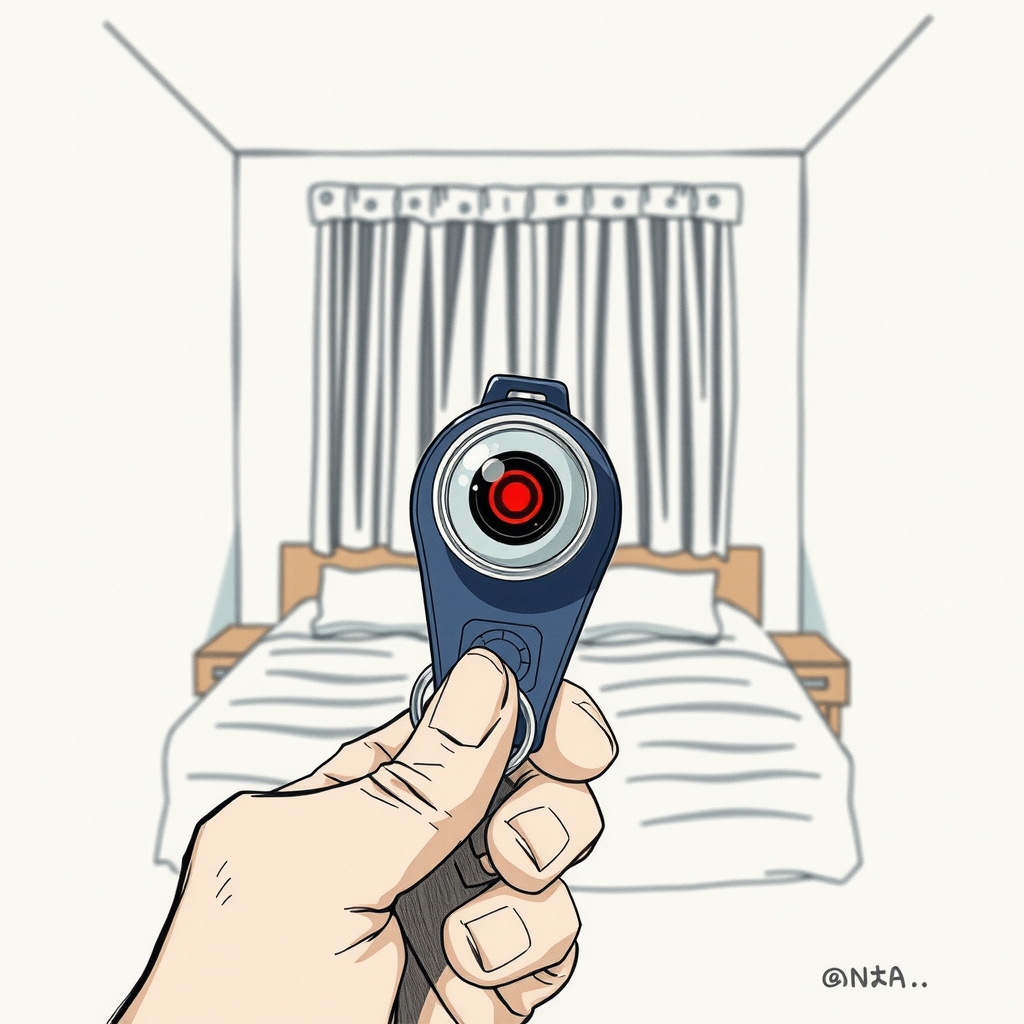
The Object on the Nightstand
The item police say did the recording was small enough to be mistaken for nothing at all: a miniature camera built into the shape of a car key, the kind of object a man empties from his pocket without thinking when he walks into a hotel room.
On August 31, 2026, police referred the 59-year-old principal of an Osaka municipal elementary school to the Osaka District Public Prosecutors Office on suspicion of seiteki shitai-tō satsuei — sexual imagery recording. The allegation, as reported by MBS, Yomiuri Television and Kansai Television, is that on August 11 at a hotel in Osaka, while receiving sexual services, he used that key-shaped camera to film a female employee's body without her consent.
He was not arrested. The case moved by shorui sōken — referral of the papers to prosecutors while the suspect remains at liberty, the ordinary route in Japan for a suspect who is cooperating, has fixed residence, and is not thought likely to flee or tamper with evidence. Prosecutors will now decide whether to charge him.
Neither his name nor the name of his school has been released. Neither has the name of the business the woman worked for.
What He Told the City
August 11 is Mountain Day, a national holiday. There were no classes.
According to Yomiuri Television, the principal has not reported to work since the incident. Questioned by the city, he acknowledged the allegation, saying: "I am very sorry."
The Osaka City Board of Education called the matter deeply regrettable, said that trust in the city's school education had been "seriously damaged," and pledged to establish the facts, handle the case strictly, tighten conduct standards for staff on and off duty, and work to restore public confidence. MBS reported that the school had begun its new term the week before, and that a briefing for parents was planned.
Reporting has not disclosed how the case came to police attention. That gap should be read as a gap and nothing more.
The Statute Is Three Years Old
The charge here did not exist before the summer of 2023, and that is the part of this story with a longer reach than one man's career.
Japan had no national voyeurism offense. Filming without consent was prosecuted under prefectural nuisance-prevention ordinances — meiwaku bōshi jōrei — forty-seven separate instruments with forty-seven different scopes. Most reached conduct in public places, on public transport, or in places where people ordinarily undress: changing rooms, public baths, toilets. Their penalties were modest. And because they were prefectural, a case could stall on the question of which prefecture the filming happened in.
That framework had an obvious hole in it, and the hole was shaped almost exactly like this case. A woman who undresses in a hotel room as part of paid work is not in a changing room and not in public. She has consented to be seen. She has not consented to be recorded — and in an ordinance regime built around location, that distinction was difficult to charge.
The Act on Punishment of Acts Related to Photographing Sexual Body Parts, and on Deletion of Electromagnetic Records of Sexual Images Recorded in Seized Articles — known in practice as the satsuei-zai law — took effect on July 13, 2023. Article 2, paragraph 1 sets out four categories of prohibited conduct. The first is the one at issue here: secretly photographing a person's sexual body parts, without legitimate reason, where the person has not knowingly exposed themselves in public. The penalty is up to three years' confinement or a fine of up to ¥3 million. Attempts are punishable.
The statute moved the legal question off the map and onto consent. It stopped asking where the woman was standing and started asking whether she agreed to the recording. Consenting to a service is not consenting to a file.
Eight Thousand Cases
The volume tells its own story. The National Police Agency's crime-situation report for 2024 — the first full calendar year the law was in force — recorded 8,436 clearances under the sexual imagery recording statute, up 232.4 percent year on year against a 2023 figure that covered less than six months.
Some of that increase is arithmetic. Much of it is not. A national offense with real penalties gave police a charge they could file anywhere, and gave complainants a reason to come forward that a patchwork of local ordinances never did.
Where those complaints originate has changed too. In November 2025, Tokyo's Metropolitan Police arrested a sitting Tokushima prefectural assembly member, then 64, on suspicion of secretly filming a woman in her twenties from a dispatch-type sex business at a business hotel in Minato Ward. He admitted the filming. He was released days later after a court rejected prosecutors' request to detain him. The detail worth keeping from that case is procedural: according to Jiji Press and the Kochi Shimbun, the woman told the shop she worked for that a customer had filmed her, and the shop contacted police.
That is a reporting channel that did not meaningfully exist a decade ago. Sex businesses in Japan operate under licensing and notification regimes that give them reason to keep a distance from police. When they start functioning as the intake point for criminal complaints by their own workers, something structural has shifted — the workplace, not just the woman, is treating the recording as the offense.
Osaka Has Been Here Before This Year
The city's own disciplinary record makes the pattern local as well as national.
On March 31, 2026, the Osaka City Board of Education dismissed a 26-year-old full-time lecturer at a municipal junior high school. Between September and October 2025, according to the city's press release, he used a smartphone's video function to film the body of a female employee at a men's esthetic salon in Osaka without her consent. He was dismissed under the Local Public Service Act.
Five months later, the city is announcing that a principal — the senior figure in a school building, the person who signs off on child-safeguarding policy — has been referred to prosecutors over the same category of conduct against the same category of victim, with a purpose-built concealed device rather than a phone.
The board's response to both was the same language about tightening conduct standards. The recurrence is the argument against that language being sufficient.
What Happens Now
Prosecutors will decide on charges. Disciplinary proceedings by the board run on a separate track and, on the city's own recent practice, can end in dismissal regardless of whether a criminal conviction follows. He is presumed innocent; no charge has been filed.
Two facts about this case are worth holding apart. The first is institutional: a public school principal, absent from his building since the day in question, with parents to be briefed at a school that had just started its term.
The second is the one that will outlast it. A woman at work in a hotel room in Osaka is now, in law, a person who can be filmed only with her agreement — and the mechanism that turns that principle into a case file is her saying so. Three years ago, the same object on the same nightstand would have been a much harder thing to charge.
Sources: MBS News, "Suspected filming with key-shaped camera: Osaka municipal elementary school principal, 59, referred to prosecutors," August 31, 2026; Yomiuri Television, "Osaka municipal elementary school principal, 59, referred to prosecutors," August 31, 2026; Kansai Television, "Osaka municipal elementary school principal, 59, referred to prosecutors over hotel filming," August 31, 2026. Statutory provisions are drawn from the Act on Punishment of Acts Related to Photographing Sexual Body Parts, etc. (in force July 13, 2023). Clearance figures are from the National Police Agency's 2024 crime-situation report. The November 2025 Tokushima case is as reported by Jiji Press and the Kochi Shimbun; the March 2026 dismissal is from an Osaka City Board of Education press release dated March 31, 2026. The suspect in the present case has not been named by Japanese media, no charge has been filed, and he is presumed innocent.