The Pitch
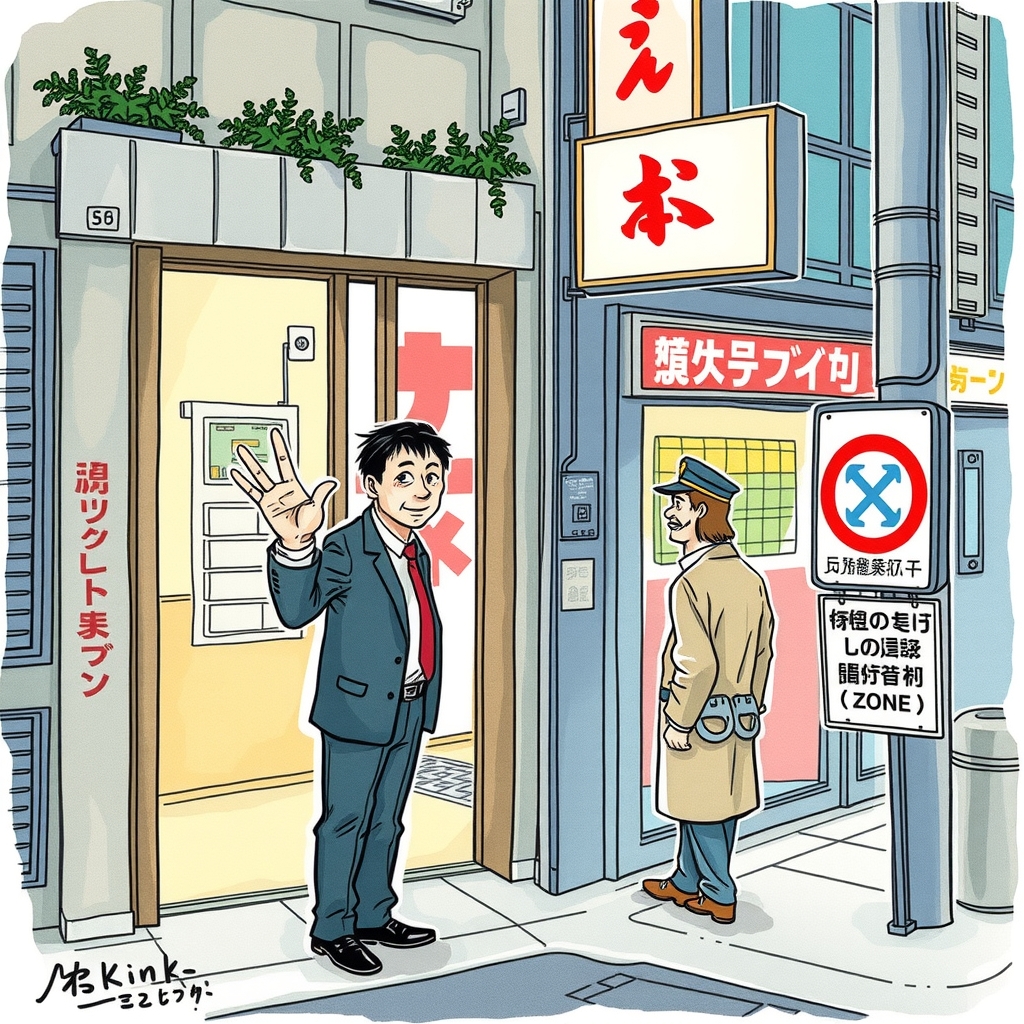
The line, as police recorded it, was a sentence of inventory: "Onna no ko dō desu ka. Jū-nin kurai imasu yo." How about girls? We've got about ten.
The man who said it was 43 years old, a resident of the Taira district of Iwaki, Fukushima Prefecture, who described himself to police as a restaurant employee. He said it on a street in Taira Sanchōme on the night of August 26, 2026, inside a zone where the city has banned exactly that sentence. The man he said it to was a police officer working an enforcement detail.
According to Fukushima Central Television, the officer did not identify himself. He accepted the pitch and walked with the tout — long enough to establish that the solicitation was real and led somewhere — then arrested him on the spot, in flagrante, for violating the Iwaki City Ordinance on the Prevention of Touting.
The two outlets that reported the case give slightly different clocks. The Fukushima Minyu put the arrest at about 10:20 p.m.; Fukushima Central Television gave a time of about 10:05 p.m. Neither reported whether the man has admitted or denied the allegation.
Twenty-four hours later and 900 kilometers to the southwest, the same thing happened again.
Oita, the Following Night
Just before 11 p.m. on August 27, in the Miyakomachi entertainment district of Oita City, a 35-year-old man approached three men on the street and invited them to become customers of a shakō inshokuten — a licensed hospitality food-and-drink business — where OBS Oita Broadcasting reports he worked.
All three were plainclothes officers. The Oita-Chūō Police Station and the prefectural police's Community Safety Investigation Division were running a joint enforcement operation in the district that night. He was arrested at the scene under the Oita Prefecture Nuisance Prevention Ordinance and, according to OBS, has admitted the allegation.
Two cases, two prefectures, two different legal instruments — one a municipal ordinance, the other a prefectural one — and an identical operational method. In neither case did a member of the public complain, testify, or appear. The state supplied the customer.
Iwaki's Ten Weeks
What makes the Iwaki arrest more than a police-blotter item is the sequence it completes.
Before this summer, the Iwaki-Chūō Police Station had not made an arrest under the city's touting ordinance since November 2024.
Then, on the night of June 17, 2026, officers arrested a 37-year-old man in the food-service trade on a street in Taira Tamachi. His pitch, as reported: "Ninety minutes, ¥4,000, a girl one-on-one." The passerby he chose was an officer on an enforcement detail, who let himself be led all the way to the shop before making the arrest. Fukushima Central Television noted at the time that it was the first arrest under the ordinance in the station's jurisdiction in roughly one year and seven months.
On July 15, a 24-year-old man was arrested in the Taira nightlife district for a nearly identical pitch — "A girl will be with you. One-on-one" — delivered, again, to an investigator. FTV Fukushima Television reported that aggressive street touting had become entrenched in Iwaki and that police were stepping up enforcement.
August 26 makes three arrests in ten weeks, after nineteen months of none. The change is not on the sidewalk. It is in the deployment.
What the Ordinance Actually Says
The Iwaki ordinance is City Ordinance No. 46, enacted July 3, 2015 and in force since August 1 of that year. It has been amended twice, most recently in December 2024.
Its stated purpose, in Article 1, is narrower than the label suggests: to prevent touting connected to sex-industry-related businesses in public places that causes residents significant unease and nuisance, and thereby to preserve the safety and quiet of daily life. This is not a general anti-hawking law. It does not reach the man handing out izakaya coupons.
Article 2 defines kyakuhiki kōi — touting — as singling out a specific person and inviting them to become a customer of a business. A separate defined term covers calling out to no one in particular, or handing out and displaying flyers.
Article 3 prohibits both, within zones the mayor designates by regulation, when the invitation is to (1) a business providing hospitality with food and drink, or (2) "the provision of acts that arouse sexual curiosity." The clause then adds the phrase that does the real work on a street like Taira Sanchōme: it applies equally to businesses pretending to provide such acts. A promise of ten women is an offense whether or not ten women exist. Article 3's second paragraph extends the ban to touting for sex-industry information services — the storefront guide counters. Article 4 makes it an offense simply to loiter in a designated zone intending to tout.
The penalty is modest. Article 6 sets a maximum of three months' confinement or a fine of up to ¥200,000; for a habitual offender, six months or ¥500,000. The December 2024 amendment swapped the old term chōeki for kōkin-kei, "confinement," tracking the national Penal Code reform that took effect June 1, 2025 and merged Japan's two custodial sentences into one. The substance did not change.
Article 7 is the provision that matters most to the businesses paying for the sidewalk. Under its dual-liability clause, when an employee commits the offense in the course of the employer's business, the company or proprietor is fined as well as the individual. The tout is the defendant. So is the shop.
And Article 8, unusually for a municipal penal ordinance, instructs that it must not be applied so as to unduly infringe anyone's rights, or abused for purposes outside its own.
Why It Is Done This Way
Street touting is an offense with a structural evidentiary problem: the only witness is a stranger who has already walked away.
A civilian pitched at 10 p.m. in a nightlife district has little reason to file a report, and by the time anyone asks, generally cannot identify the man or reconstruct the wording. The offense turns entirely on what was said and where the speaker was standing. Absent a witness who will testify to both, there is no case.
The decoy solves it. An officer who receives the pitch is a witness who documents the sentence, fixes the location inside the designated zone, follows the tout far enough to establish that the solicitation was genuine, and is available for the file. It is also why these arrests are so often genkōhan — in flagrante — rather than the product of a later investigation.
The tactic is not local. It has become the standard instrument of street-level nightlife enforcement across Japan. Sapporo police have been arresting Susukino touts for pitches delivered to plainclothes officers, in some cases weeks after the fact. Saitama arrested seven men in July who had approached investigators. Miyagi's first arrest of a host-club employee for touting came the same way. In Nagoya's Sakae district on August 25, a 110-person sweep ahead of the Asian Games produced recurrence-prevention orders rather than arrests — the softer rung of the same enforcement ladder.
The Limits
What a three-month maximum buys is not deterrence in any conventional sense. A ¥200,000 fine is a cost of doing business in a district where a single table can exceed it.
What it buys is a record, and the record is the point. An arrest documents which shop the tout was walking customers toward. Under Article 7, that shop can be fined for a sentence its employee spoke on a sidewalk. Where the venue holds a licence, the same paper trail can support administrative action by the prefectural public safety commission, which controls it.
None of that reaches the underlying arrangement. The three men arrested in Iwaki this summer were, on the reporting available, foot soldiers: one who described himself as a restaurant employee, one in the food trade, one aged 24. Nothing published identifies who was paying them, on what terms, or what waited at the end of the walk. Fukushima Central Television's account of the June arrest — the officer allowed himself to be escorted all the way to the shop — suggests police were interested in that address. What came of it has not been reported.
Both investigations are described as continuing.
| Detail | Iwaki | Oita |
|---|---|---|
| Date of arrest | August 26, 2026 (about 10 p.m.) | August 27, 2026 (just before 11 p.m.) |
| Location | Taira Sanchōme, Iwaki, Fukushima Pref. | Miyakomachi, Oita City |
| Suspect | Man, 43, self-described restaurant employee | Man, 35, hospitality food-and-drink employee |
| Alleged act | "How about girls? We've got about ten" | Invited three men to become customers |
| Recipient of pitch | Police officer on enforcement detail | Three plainclothes officers |
| Statute | Iwaki City anti-touting ordinance (Ord. No. 46, 2015) | Oita Prefecture Nuisance Prevention Ordinance |
| Maximum penalty | 3 months' confinement / ¥200,000 fine | Set by prefectural ordinance |
| Plea | Not reported | Admits |
Sources: Fukushima Minyu Shimbun and Fukushima Central Television (FCT) on the August 26 Iwaki arrest; FCT and FTV Fukushima Television on the June 17 and July 15 Iwaki arrests; OBS Oita Broadcasting on the August 27 Oita arrest; and the text of Iwaki City Ordinance No. 46 of 2015 as published by the City of Iwaki. This report translates and synthesizes those accounts. Suspects are described only as the sources describe them; an arrest is an allegation, not a finding of guilt.