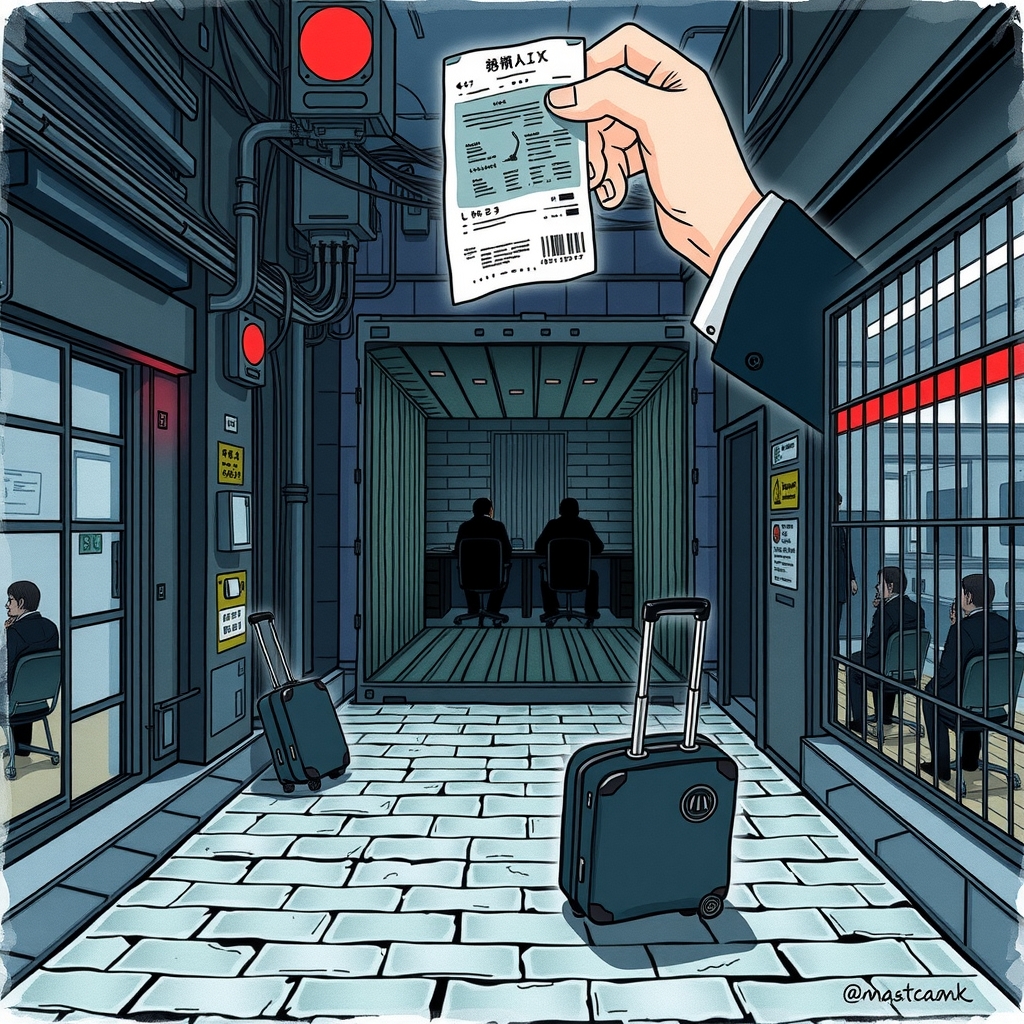
The Referral
The woman was nineteen and wanted a job in the sex trade. She did what thousands of women in Tokyo do: she asked someone who knew Kabukicho to introduce her to someone who was hiring.
According to reporting by the Tokyo Shimbun and the Yomiuri Shimbun, the acquaintance she asked introduced her to a man who was not hiring for a brothel. He was, police say, hiring for something else entirely.
On August 17, 2026, the Tokyo Metropolitan Police arrested that man for the fifth time. He is 26, identified in Japanese reports as Yamao (山尾輝斗), described by police as a member of a group under the designated organized-crime syndicate Sumiyoshi-kai, and already under indictment in earlier cases. Investigators allege he worked as a recruiter — the man who found bodies inside Japan for fraud operations run out of Southeast Asia.
The Charge
The offense he was arrested on is not one that appears often in Japanese crime reporting.
Article 226 of the Penal Code — shozai kokugai iso mokuteki ryakushu oyobi yukai, kidnapping or abduction for the purpose of transporting a person outside the country where they are — carries a minimum of two years' imprisonment and no option of a fine. It is a substantially heavier charge than ordinary kidnapping, and it exists precisely because moving a person across a border strips away everything that would otherwise let them walk away.
The allegation, as reported by the Jiji Press, the Sankei Shimbun and the broadcaster khb: in early October 2025, the man and unidentified accomplices told the then-19-year-old woman that she could earn abroad — that some girls were pulling in five million yen a week — took her to a lodging facility in Tokyo's Arakawa Ward, and moved her from Haneda Airport to Kuala Lumpur International Airport in Malaysia.
Police told khb she was recruited on the understanding that she would be working at adult-entertainment establishments in Cambodia.
Four Compounds
She did not work in adult entertainment.
From Malaysia she was taken into Cambodia. According to the Yomiuri, she was held at three compounds in the country's northwest, then at a site in Johor Bahru, Malaysia — four locations in all. What she was made to do there was kakeko work: the person on the phone, the voice that places the fraudulent call. The Yomiuri reports the scripts she was made to run included impersonating police officers.
She had not been told what the work was before she left Japan. She was not paid. Her passport, according to reporting on the case, was taken from her after she cleared departure at Haneda.
The Yomiuri adds a detail that says something about how these operations recruit: several people she knew from Toyoko — the stretch of pavement beside the Toho Building cinema complex in Kabukicho where runaway and at-risk young people gather — were already at the compounds when she arrived.
The Exit
What ended it was a rumor about Laos.
In July 2026, the woman learned she was to be moved on again, this time to a compound in Laos. The Tokyo Shimbun reports that she concluded she might never get home. She left the site and went to the Japanese Embassy in Malaysia and asked for protection.
That is how the case surfaced. There was no raid, no intercepted transfer, no tip from inside the syndicate. There was a nineteen-year-old who worked out that the next flight was the last one, and walked into a building with a Japanese flag on it.
A Fifth Arrest, and a Pattern
This is the fifth time the Metropolitan Police have arrested the same man. The Sankei reports that his four previous arrests involved four other people, men and women, all allegedly kidnapped for transport abroad — among them a man in his thirties taken from Kabukicho in July 2025, a woman in her twenties, and a man in his forties. Investigators describe his role consistently across all of them: the domestic end of the pipeline, working Tokyo's nightlife districts.
He was not the only such case in the news that day. On the same date, Jiji reported that Hiroshima prefectural police had arrested two women — a 32-year-old restaurant company representative and a 30-year-old former company executive — on suspicion of the same Article 226 offense. Their alleged method was different and, in its way, more unsettling: they are said to have recruited through job interviews, telling a 47-year-old applicant he would earn three hundred thousand yen doing luggage transport, then moving him from Kansai International Airport to Taiwan's Taoyuan Airport between February and March. He was subsequently moved to Thailand. He, too, escaped to a Japanese embassy. One of the two women admits involvement; the other denies the charge.
The Scale Behind It
The individual cases are small numbers. The environment they feed is not.
In June 2026, FNN Prime Online reported that Cambodian authorities had raided 95 fraud compounds in a single month-long sweep, detaining more than 5,400 people, among them 72 Japanese nationals. Five were being processed for repatriation at the time of the report; sixty-seven remained under questioning at police stations across the country. NHK reported the same month that National Police Agency officials had met with the Cambodian National Police to strengthen cooperation on cases involving Japanese nationals.
Every one of those 5,400 people arrived by some route. The route in this case ran through a request for sex-industry work in Kabukicho.
Why the Sex Trade Is the On-Ramp
Japan has spent two years building law specifically to break the referral layer that sits between vulnerable young people and the adult-entertainment industry.
Amendments to the fuei-ho — the Businesses Affecting Public Morals Regulation Act, which licenses host clubs, cabaret clubs and much of the night economy — took effect in June 2025 and again in November, banning the manufactured-romance debt tactics of predatory host clubs and outlawing the scout-back: the kickback paid to a scout who routes a woman into sex work. Enforcement against the large scout organizations has run continuously since, and this site has covered arrest after arrest in that campaign through 2026.
Those measures regulate what happens when the referral ends at a Japanese business with a license, an address and a public safety commission that can pull its permit.
This case is what happens when the referral ends at an airport.
The informal network that makes it possible is the same one the fuei-ho amendments were written to target — an acquaintance who knows people, a young woman with no other way into the labor market she is trying to enter, and no verification anywhere in the chain of who is actually on the other end. What changed is the destination. A woman routed into a licensed Japanese establishment can be found, counted, and in principle reached by the state. A woman routed onto a flight to Kuala Lumpur is outside all of it within hours, and the only enforcement tool that reaches her is a criminal charge filed after she gets herself back.
In this case she did. Police are still investigating who was above the man they arrested.
Sources: Jiji Press (August 17, 2026); Sankei Shimbun via Yahoo News Japan (August 17, 2026); Tokyo Shimbun (August 17, 2026); Yomiuri Shimbun (August 17, 2026); khb Higashi-Nippon Broadcasting (August 17, 2026). Background: Jiji Press on the Hiroshima arrests (August 17, 2026); FNN Prime Online on the Cambodian sweep (June 2026); NHK on National Police Agency–Cambodian National Police consultations (June 2026); National Police Agency materials on the 2025 fuei-ho amendments. The suspect's given name is written 輝斗 in Japanese reports and its reading is not given; he is referred to here by surname only. Allegations described are police allegations; the suspect's response to this arrest has not been reported. The woman is not identified in any source and is not described further here. Details vary slightly between outlets on the number and location of compounds; the account above follows the Yomiuri and Jiji versions.