
Shinbashi is where Tokyo keeps its salarymen. Not the executives — those are two hundred metres east in the Shiodome towers, behind glass, in buildings with atria. Shinbashi proper is the other thing: the low blocks under the Yamanote viaduct, the standing bars with beer crates stacked outside at four in the afternoon, the yakitori smoke, the guy asleep on the steps of the SL Square plaza with his tie still knotted. It is the least glamorous major node on the loop line and it has zero interest in fixing that. Every year a TV crew comes down here and interviews drunk men on the plaza about the economy, and every year the men say something bleak and funny, and that is the town's entire public image and it is basically accurate.
It is also, for the same reasons, dense delivery-health territory. Hotels near the station, expense accounts, a train home that runs late, and thousands of men with two hours to kill between the office and the last service. Cityheaven lists 52 shops in the Shinbashi–Shiodome block.
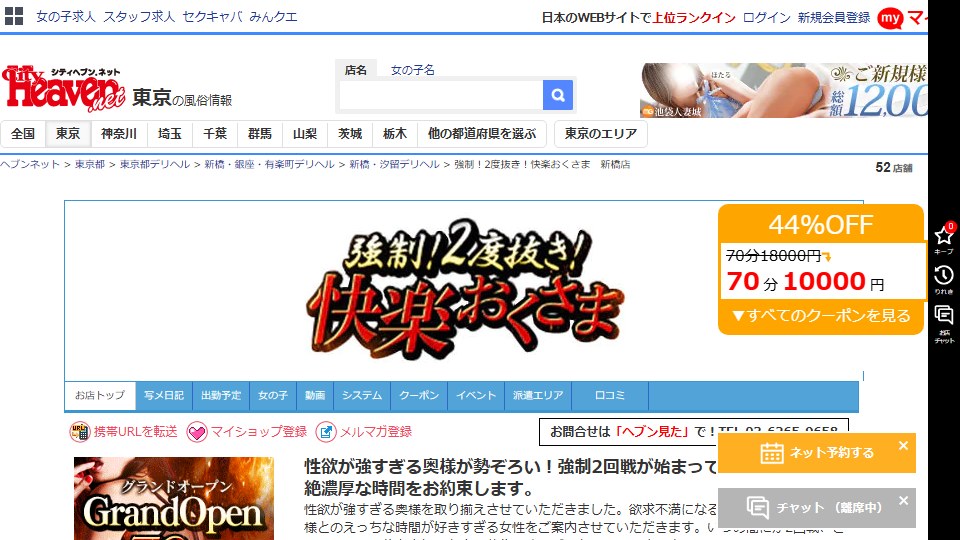
The one I want to talk about is Kyosei! Nidonuki! Kairaku Okusama Shinbashi-ten — 強制!2度抜き!快楽おくさま 新橋店. Tel 03-6265-9658. Cityheaven files it as delivery health, gekiyasu class — 激安, the discount tier — dispatching from 東京都新橋(港区), open 0:00–24:00, 365 days. The name translates to something like Forced! Twice Off! Pleasure Wives, Shinbashi Branch, which tells you the register we are operating in. The tagline on the top page: 性欲が強すぎる奥様が勢ぞろい!強制2回戦が始まってしまいます! — A full lineup of wives with too much sex drive! A second round is going to start whether you planned one or not!
I did not come here for the tagline. I came because I opened four tabs on this listing and the numbers on them did not match.
Tab one: the system page
Click システム — the price system tab. This is the official board. Here it is, complete, exactly as printed:
| Course | Price | Per minute |
|---|---|---|
| First visit, one time only, 70 min | ¥10,000 | ¥143 |
| 70 min | ¥18,000 | ¥257 |
| 80 min | ¥20,000 | ¥250 |
| 90 min | ¥24,000 | ¥267 |
| 100 min | ¥28,000 | ¥280 |
Below it, one line: 別途、交通費、自宅出張費 等 — separately: transport, home-visit fee, etc.
That is the entire system page. I want to be clear about how little that is. No nomination fee. No repeat-nomination fee. No extension rate. No option list. No cancellation policy. No payment methods. No membership tiers. Most shops fill this page; this one has a five-row table and a fragment of a sentence, and the operative word in that fragment is 等 — etcetera — an open bracket around an unspecified number of charges you will hear about on the phone.
Look at the shape of the curve, though, because it is unusual. Per minute: ¥257, ¥250, ¥267, ¥280. It dips at 80 minutes and then climbs. That is the opposite of how time is normally sold. The marginal blocks make it plainer:
| Step up | Extra time | Extra cost | Rate for that block |
|---|---|---|---|
| 70 → 80 | 10 min | ¥2,000 | ¥200/min |
| 80 → 90 | 10 min | ¥4,000 | ¥400/min |
| 90 → 100 | 10 min | ¥4,000 | ¥400/min |
So on the official board, the cheapest ten minutes in the building are the ones between 70 and 80, and the moment you cross 80 the price of time doubles and stays doubled. Fine. Noted. Buy the 80.
Hold that thought for about ninety seconds.
Tab two: the coupon page
Three coupons. All three carry an open-ended expiry — 無期限, no limit — which means they are not promotions, they are a second price list wearing a promotion's clothes.
1. 初回1回だけ使える激特クーポン — the first-visit-only special. 70 minutes, ¥10,000, badged 44% OFF against ¥18,000. Live since 2026/02/15.
2. ご新規様限定イベント料金 — じゅんか (34). 90 minutes, ¥15,000, badged 38% OFF against ¥24,000. Live since 2026/06/27.
3. ご新規様限定イベント料金 — のどか (30). 80 minutes, ¥13,000, badged 35% OFF against ¥20,000. Same start date.
All three say 必ず【ヘブンクーポン】を見たとお伝えください — you must say "Heaven coupon." All three list the extras as 別途、交通費、自宅出張費、tax 等. Note that the extras line has quietly grown a fourth item since the system page.
Two of those three coupons are attached to a specific woman by name, age and measurements. That is the part I filed away as interesting — a shop discounting individuals, which is normally a demand signal you can read straight off the page. Junka, at 34, is the single oldest woman on this roster. Nodoka is 30.
Then I opened the third tab and the reading changed completely.
Tab three: the event page, where the actual prices live
イベント. The event tab. Running since 2/15, headed ご新規様限定超激安料金♪. The instruction here is different: 必ず店頭にて「ヘブンネットの割引コースを見た」とお申し出ください — you must say "I saw the Heaven Net discount course." Not "Heaven coupon." A different phrase.
And underneath it is a six-rung ladder that appears nowhere on the system page and nowhere on the coupon page:
| Course | Price | Per minute | Note on the page |
|---|---|---|---|
| 70 min | ¥10,000 | ¥143 | Shinbashi/Shiodome area only |
| 70 min | ¥11,000 | ¥157 | Second-time customers OK, all 23 wards, distant OK |
| 80 min | ¥13,000 | ¥163 | |
| 90 min | ¥15,000 | ¥167 | |
| 100 min | ¥18,000 | ¥180 | |
| 120 min | ¥22,000 | ¥183 |
別途、交通費、tax 等. And then, without irony, directly beneath: 安心安全の明朗会計システム!!!! — a safe, reassuring, transparent accounting system!!!!
Now put the two boards side by side.
| Duration | System page | Event page | Difference |
|---|---|---|---|
| 70 min | ¥18,000 | ¥10,000 / ¥11,000 | −¥8,000 / −¥7,000 |
| 80 min | ¥20,000 | ¥13,000 | −¥7,000 |
| 90 min | ¥24,000 | ¥15,000 | −¥9,000 |
| 100 min | ¥28,000 | ¥18,000 | −¥10,000 |
| 120 min | — | ¥22,000 | not on the board at all |
The official price list is dominated at every single duration, by ¥7,000 to ¥10,000 a booking. And it is worse than that, because the comparison is not only vertical:
- The event ladder's 100 minutes (¥18,000) costs exactly what the system board charges for 70. Same money. Thirty extra minutes. The difference is one sentence you say on the phone.
- The event ladder's 120 minutes (¥22,000) costs ¥2,000 less than the system board's 90. More time, less money.
- The system board has no 120-minute course at all. The longest thing it will sell you is 100 minutes at ¥28,000 — for which the event page will sell you two full hours and hand you back ¥6,000.
There is no page on this listing that mentions the existence of the other pages. The system tab does not say "see events." The coupon tab does not say "a general discount ladder also exists." A customer who opens the shop's own price system, reads it, and calls up quoting it will be charged ¥18,000 for the 70 minutes his neighbour just bought for ¥10,000, and every number he was shown was true.
The two coupons that discount nothing
Now go back to Junka and Nodoka.
Junka's personal coupon: 90 minutes, ¥15,000, 38% OFF. The event ladder, open to anyone, with any woman: 90 minutes, ¥15,000.
Nodoka's personal coupon: 80 minutes, ¥13,000, 35% OFF. The event ladder, open to anyone, with any woman: 80 minutes, ¥13,000.
Identical. To the yen. The "special event pricing for Junka" is the house discount price with a photograph stapled to it. The 38% and the 35% are measured against a board that the shop's own event page has already superseded, and the incremental discount for choosing these two specific women over any of the other seventeen is zero yen.
I had assumed, on tab two, that I was looking at a shop marking down its two least-booked women. On tab three it turns out I was looking at a shop advertising its standard rate twice, under two women's names, at no cost to itself. Which is either sharper marketing than the rest of this listing would suggest, or nobody is minding the tabs. Given that the system page has not been reconciled with the event page since February, I know which way I would bet.
Either way the practical consequence is the same and it is worth stating flatly: there is no reason to book Junka or Nodoka for the price. Book them because you want to, at a rate you could have had with anyone.
Which rung to actually buy
The event ladder is where the money is, so here is its marginal structure — what each step up actually costs, working from the ¥10,000 base:
| Step up | Extra time | Extra cost | Rate for that block |
|---|---|---|---|
| 70 → 80 | 10 min | ¥3,000 | ¥300/min |
| 80 → 90 | 10 min | ¥2,000 | ¥200/min |
| 90 → 100 | 10 min | ¥3,000 | ¥300/min |
| 100 → 120 | 20 min | ¥4,000 | ¥200/min |
It zigzags. And two rungs on this ladder are strictly bad buys:
Do not buy 80 minutes. You paid ¥300/min to climb onto it, and the very next ten minutes cost ¥200. For ¥2,000 more — the cheapest ten minutes on the ladder — you are at 90.
Do not buy 100 minutes. Same trap, larger. You paid ¥3,000 for the ten minutes from 90, and then the next twenty minutes cost ¥4,000. Anyone buying the 100 is paying ¥300/min for a block immediately followed by ¥200/min, in twice the quantity.
Which leaves three sane purchases: 70 (¥10,000 or ¥11,000), 90 (¥15,000), or 120 (¥22,000) — and 70 → 120 works out at ¥240/min across the whole extra fifty minutes, still under every single rate on the official board.
Note also that this is the exact reverse of the advice the system page gives. On the board, 70 → 80 is the cheapest block and everything after 80 doubles. On the ladder, 70 → 80 is the most expensive block and it gets cheaper after. The same shop's two price lists give precisely opposite instructions about the same five courses. If you read only one of them, you will optimise into the wrong course.
The ¥1,000 that buys geography — and the cliff after it
The second rung is the cleverest line on the page and it is easy to skim past:
70分11000円割引コース!!(2回目の方も可&都内23区、遠方も可)
¥11,000 for the same 70 minutes, and in exchange for that extra ¥1,000 you get two things. First, the geo-fence comes off: the ¥10,000 rate is 新橋・汐留周辺限定 — Shinbashi/Shiodome only — while ¥11,000 travels anywhere in the 23 wards, and further. Second, and this is the real content: 2回目の方も可. Second-time customers welcome.
Everything else in this promotion is headed ご新規様限定, first-timers only. So the ladder as it applies to a human being over time looks like this:
| Visit | What you can get | 70-min price | Per minute |
|---|---|---|---|
| 1st | First-visit coupon, Shinbashi area | ¥10,000 | ¥143 |
| 2nd | The ¥11,000 rung | ¥11,000 | ¥157 |
| 3rd | Nothing. The system board. | ¥18,000 | ¥257 |
A 64% increase between your second visit and your third, with no intervening step. That is the whole loyalty structure of this business: two subsidised visits, then the cliff. And ¥1,000 — ¥14 a minute — is what the shop charges to extend the honeymoon by one booking, which is the cheapest loyalty concession I have costed anywhere in this trade. It is also, obviously, the last one you get.
I read the whole thing as an acquisition machine rather than a retention one, and I do not think that is a criticism so much as a description. Every discount in this building points at somebody who has never called. Nothing points at the man calling for the fourth time. If you are that man, you are funding the ladder.
The roster, and the hour you call
Nineteen women listed. Every published age, sorted: 25, 25, 26, 26, 26, 27, 27, 28, 28, 28, 29, 29, 30, 30, 30, 31, 32, 32, 34.
Median 28. Mean 28.6. Range 25–34. Twelve of nineteen — 63% — are in their twenties.
Worth a beat on that, because the shop's name says 奥様 (wives) and its tagline says the same, and 奥様/人妻 in this industry's vocabulary normally signals mid-thirties and up. This roster's oldest woman is 34. Its own concept essay, further down the page, calls them 普通の女の子 — ordinary girls. Three different descriptions of the same nineteen people on the same page. It is the price lists all over again.
The schedule tab is more revealing than the roster, and here is the thing I did not expect. All nineteen women are listed for exactly six of the next seven days. Not one at five, not one at seven. Nineteen for nineteen. Shifts run from 11 hours (Junka, Kahori, Erika) to 17 hours (Emi, 12:00–5:00), averaging 12.9 hours. Six days at roughly thirteen hours is about a 77-hour listed week, each, across the entire roster, with the day off staggered so the board never empties. That is a rostering rule, not a coincidence, and I would take it as the single most informative number on the listing about how this shop is run.
Now overlay it on the clock. Here is today's actual coverage — Thursday 20 August, with Erika and Nodoka both off:
| Time | Women on shift |
|---|---|
| 06:00–07:00 | 3 |
| 07:00–10:00 | 4 |
| 10:00–12:00 | 5 |
| 12:00–16:00 | 9 |
| 16:00–18:00 | 11 |
| 18:00–19:00 | 14 |
| 19:00–00:00 | 13 |
| 00:00–04:00 | 12, falling to 10 |
| 05:00–06:00 | 5 |
The shop advertises 0:00–24:00, 365 days, and that is true — but "24 hours" here means a roster that peaks at fourteen women at six in the evening and bottoms out at three at six in the morning. A 4.7× swing, at a completely flat price. The ¥10,000 first-visit rate carries no time restriction whatsoever, so the 6am customer and the 6pm customer pay the same money for rosters that differ by 79%.
Read that as a warning if you were thinking of calling at dawn. Read it as an opportunity if you were not: at 6am those three are near-certainly free, and at 6pm you are one of a great many men trying to book fourteen women in the busiest hour of the busiest commuter town on the Yamanote line.
One live snapshot while I had the page open, 12:48 on a Thursday: five women showing 現在待機中 — available now — out of nine then on shift. Ami, Keiko, Sorahime, Junka, Ran. The other four all showed a next-available time of 13:16, 13:19, 13:19 and 13:22 — four slots clustered inside six minutes, which reads more like a booking-system rule than four coincidental finishes. Take it for what it is: a lunchtime idle rate of roughly half. Of the five sitting idle, one was Junka — the woman with her own discount coupon — and one was Ran, who writes more of this shop's diary than anyone else. Which brings me to the quietest number here.
One review. Nineteen women.
The 口コミ tab has one review. Not one this month. One, total, across the entire roster.
It is for Tsukasa (29), visited 31 March 2026, published 2 April, by a Gold-ranked reviewer with 49 reviews and 863 followers — so not a throwaway account. He booked through the net reservation system. He scored it:
| Category | Score |
|---|---|
| The girl | 3.5 |
| The service | 3.5 |
| Price | 3.5 |
| Staff | 3.5 |
| Photos | 3.5 |
Five categories, five identical 3.5s, headed 相性しだいかも! — might come down to chemistry. His notes: the photo impression was a little different from the person, but not bad; conversation was polite, though he wished it had flowed more; the service was 可もなく不可もなく, neither good nor bad; she did what he asked; the time was kept properly; no complaints. He signs off saying it is the kind of shop where, over a few visits, you could probably find someone who suits you.
I have read a lot of these. That is a genuinely fair, genuinely unexcited review, and its unexcitement is the most useful thing on this listing — because it is all the evidence there is. For comparison, a mid-tier Yoshiwara soapland I wrote up recently carried 256 reviews across 22 women. This shop carries 0.05 reviews per woman.
The 写メ日記 board tells the same story from another angle. The eight most recent posts span 29 July to 9 August, from five women — Ran three times, Ai twice, Emi, Keiko and Juri once each. In the whole of August there are posts on five days: the 1st, 3rd, 5th, 8th and 9th. Nothing since. As I write this on the 20th, the shop's diary has been silent for eleven days, most of the roster has posted nothing this month, and the archive only reaches back to May 2026 — I cannot tell from the outside whether that is a platform retention window or the listing's actual age, and I am not going to guess.
None of that means the service is bad. The single review says it is fine. It means that if you book here you are buying almost entirely on the shop's own description of itself — and we have already established what happens to this shop's own descriptions of itself when you put two of them next to each other.
The strangest thing on the page is free
At the bottom of the top tab, under the price table, is a short essay. I have translated it close:
"What do you want from fuzoku?" Thoroughly executed service, as play content? Or simply the quality of the girls? Slightly unusual tastes, too, are something only fuzoku offers. Our shop has many women who want intense sex, and what we sell is hard play — attacking, attacking, attacking. But what customers want varies from person to person, and for one shop to meet every need is close to impossible. We do not think we can offer that much. But there is one thing we can offer with confidence: not the manualised pseudo-romance of the big chains, but the possibility of real romance. Enjoy the infinite possibilities of ordinary girls, unbound by manuals. Our reason for existing comes down to helping build that bridge.
Read that again with the shop's name over it. 強制!2度抜き! — Forced! Twice off! A brand built on a coercion joke, and underneath it a mission statement whose central sentence is we do not think we can offer that much.
I have read a great many of these listings and I have never seen a Japanese commercial page volunteer its own limits like that. It is not a good sales document. 擬似恋愛 — pseudo-romance, the simulated-girlfriend product the large chains manualise and sell — is exactly what most of this industry is, and the essay's pitch is that the alternative to a manual is ordinary people and no promises. Which is, if you take it seriously, an offer to sell you less structure for less money.
And that is coherent with everything else about the operation. The system page is nearly empty. The price lists do not reconcile. The diary is stale. The evidence base is one 3.5-star review. But the discount ladder is real, deep, and cheaper than almost anything you will find within walking distance of that plaza. This is a shop that has decided which of those things it is competing on.
What is not in any of these numbers
Say it plainly, because none of the three price lists does:
別途、交通費、自宅出張費、tax 等. Transport, home-visit fee, tax, etcetera. Four named categories and an open bracket, and not one yen figure attached to any of them anywhere on the listing. Whatever you are quoted on the phone is the first time you will see those numbers.
And this is delivery health. No room is included. The 派遣エリア page says ホテル or 自宅 — hotel or home — 出張先詳細:どこでも, anywhere. If you do not live in Tokyo, a room in Shinbashi is your cost, on top, and it is not small. The ¥10,000 headline is a headline for the woman's time and nothing else.
About the shop
Kyosei! Nidonuki! Kairaku Okusama Shinbashi-ten (強制!2度抜き!快楽おくさま 新橋店). Delivery health, gekiyasu class, Shinbashi/Shiodome, dispatching from 東京都新橋(港区). Tel 03-6265-9658 — say 「ヘブン見た」 when you call. Open 0:00–24:00, no closing days. Outcall to hotel or private residence, stated coverage: anywhere. System-page board: 70 min ¥18,000 / 80 min ¥20,000 / 90 min ¥24,000 / 100 min ¥28,000, plus a first-visit 70 min at ¥10,000. Event-page ladder (say 「ヘブンネットの割引コースを見た」): 70 min ¥10,000 Shinbashi area / 70 min ¥11,000 anywhere in the 23 wards with second visits allowed / 80 min ¥13,000 / 90 min ¥15,000 / 100 min ¥18,000 / 120 min ¥22,000, running since 2/15. Coupons (say 「ヘブンクーポン」): first visit 70 min ¥10,000; Junka 90 min ¥15,000; Nodoka 80 min ¥13,000 — all open-ended, all first-timers only, the latter two matching the general event rate exactly. Extras on all lists: transport, home-visit fee, tax, etc., none quantified. Roster of 19, ages 25–34, median 28, all nineteen scheduled six days of seven, shifts averaging 12.9 hours. One review on file. No official shop website is linked from the listing. Japanese-language phone line and page; no English support is indicated anywhere, so if that is you, settle it on the call before anything else. No under-18s admitted and none employed.
The verdict
| Item | Rating |
|---|---|
| Depth of the event ladder vs. the board (−¥7,000 to −¥10,000) | ★★★★★ |
| ¥11,000 rung: drops the geo-fence and covers a second visit | ★★★★★ |
| 120 min at ¥22,000 — cheaper than the board's 90 | ★★★★★ |
| Roster scheduling: 19 for 19 at six days a week, staggered | ★★★★☆ |
| 24/7/365, genuinely staffed at every hour | ★★★★☆ |
| The concept essay's honesty about its own limits | ★★★★☆ |
| Evening roster depth (14 women at 18:00) | ★★★★☆ |
| Zigzag ladder: the 80 and 100 rungs are traps | ★★☆☆☆ |
| Roster at dawn (3 women) vs. evening, at one flat price | ★★☆☆☆ |
| Diary board silent 11 days, and thin before that | ★★☆☆☆ |
| Named coupons offering ¥0 over the general rate | ★★☆☆☆ |
| Extras: four categories, an "etc.", and no figures | ★☆☆☆☆ |
| One review across nineteen women | ★☆☆☆☆ |
| Three price lists that contradict each other, called 明朗会計 | ★☆☆☆☆ |
| Accessibility for non-Japanese customers | ★☆☆☆☆ |
| Overall | ★★★☆☆ |
Three stars, and it is an honest three: a genuinely cheap shop with a genuinely disordered shopfront.
Because the value here is real. Two hours for ¥22,000 in Minato-ku is a serious number, and the ladder that produces it has been sitting on the event tab since February in plain sight. What the shop has not done is tell anyone. It maintains a system page that would cost you ¥10,000 on a 100-minute booking, a coupon page that markets its standard rate as a 38% discount under a woman's name, and three separate phrases you are required to recite depending on which of those pages you happened to open — and then it prints 安心安全の明朗会計システム underneath. I do not read that as a trap. I read it as a small shop that built three pages at three different times and never once opened them side by side. But the effect on a customer's wallet is identical either way, and the customer it costs most is the one who did his homework on the official price list.
So, concretely. Say 「ヘブンネットの割引コースを見た」, not 「ヘブン見た」, and not 「ヘブンクーポン」 — that one sentence is worth between ¥7,000 and ¥10,000 and it is the single highest-value thing in this article. Buy the 70, the 90, or the 120, never the 80 or the 100. If you are outside Shinbashi or coming back a second time, the ¥11,000 rung is the one that still lets you in. And go in the evening if you want to choose from fourteen rather than three — or at six in the morning if you would rather not compete for them, knowing the roster is a fifth the size and the price is exactly the same.
And on the third visit, when the board snaps back to ¥18,000: that is the shop telling you what it thinks it is worth. Decide then whether you agree.