The Word "Healing" Is Doing a Lot of Work Here
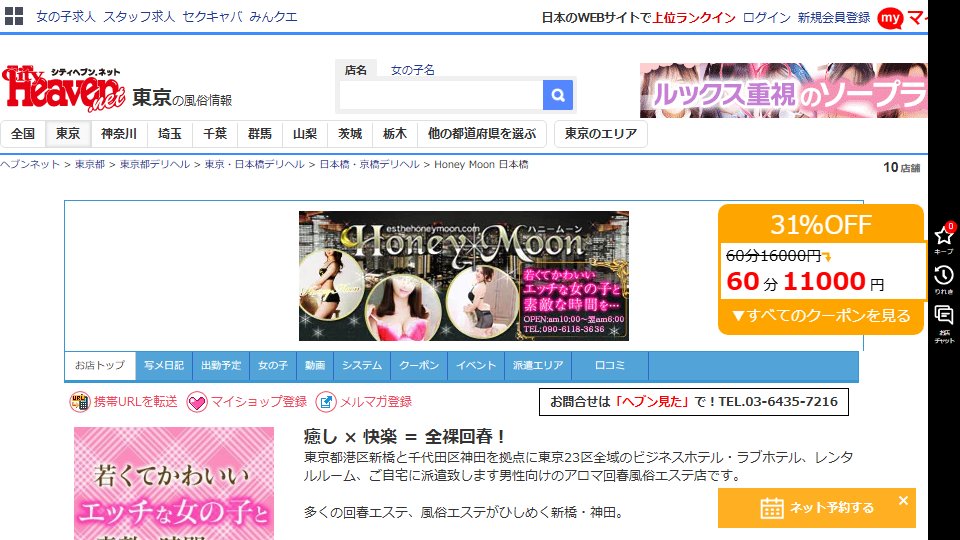
Every second shop in this business has borrowed the vocabulary of a day spa. Aroma. Relaxation. Kaishun — rejuvenation. Honey Moon Nihonbashi doesn't even pretend the borrowing is subtle: its tagline is "Healing × Pleasure = Full-Nude Rejuvenation" (癒し × 快楽 = 全裸回春), and it describes itself flatly as an aroma kaishun fuzoku-esthe house for men — a sentence that tells you exactly what it is while sounding like a wellness brochure. I respect that more than I expected to. The shops that get people in trouble are the ones where the massage language is a fig leaf and the customer genuinely can't tell what he's ordering. Here the equation is written out with the answer included.
So the question I went in with wasn't "what is this." It was narrower and more useful: when a deriheru sells itself on the healing half of that equation, does the healing half actually show up in the room — or is it a coat of paint on a standard delivery service with a ¥1,000 nomination fee?

The Ladder, and Where It Quietly Stops Being a Deal
The pricing is refreshingly legible. 30 minutes at ¥5,000. 60 at ¥11,000–12,000. 90 at ¥14,000–15,000. 120 at ¥18,000–19,000. 150 at ¥23,000. 180 at ¥26,000. The spread on the shorter courses is time-of-day dependent — book off-peak and you're on the lower number. Nomination is ¥1,000, which is cheap for Tokyo, and there is no entry fee at all, which is rarer than it should be. Transport is quoted at booking, because they dispatch across all 23 wards plus Chiba, Saitama and Kanagawa — the shop bases out of Shinbashi and Kanda even though the listing lives under Nihonbashi-Kyobashi, which tells you where the driver is starting from.
One presentation note before you get excited: the ¥11,000 hour is fronted on the page as 31% off a ¥16,000 reference price, coupon-style. I'd ignore the crossed-out number entirely. Discount theater is standard across every listing site in Japan, and the only figure that means anything is the one you actually pay — which, here, is genuinely ¥11,000.
Now run the arithmetic yourself, because the ladder tells a story. From 60 to 90 costs you ¥3,000. From 90 to 120, ¥4,000. From 120 to 150, about ¥4,500. From 150 to 180, ¥3,000. The marginal half-hour stays in the three-to-four-thousand band the whole way up — which means the long courses here are genuinely priced as long courses, not as a punishment for wanting time. That's the opposite of the usual Tokyo deriheru pattern, where the entry course is bait and every extension is where they make their margin. On this ladder, 120 minutes at ¥18,000 is the sweet spot and I'd argue it's the only course that lets a slow-paced concept do what it says.
The 30-minute at ¥5,000 I'd leave alone entirely. Not because it's a rip-off — it's arithmetically the cheapest door in the building — but because thirty minutes of a service whose entire selling point is unhurried is a contradiction you're paying to experience.
What Ten A.M. to Six A.M. Is Actually For
Twenty hours a day, no closing days. That clock isn't a flex, it's a description of the customer base. 10:00 a.m. exists for the man between meetings and the man who never went home. 6:00 a.m. exists for the end of a long night in a city where the trains stopped at midnight and the hotel was cheaper than the taxi. Nihonbashi and Kyobashi are business districts that empty out after dark, and a shop that dispatches into them at four in the morning is answering a specific, unglamorous kind of loneliness — the salaryman-shaped kind, in a single room with a desk and a kettle.
I booked into the back half of that window on purpose, because a "healing" concept at 2 a.m. is a harder test than the same concept at 8 p.m. The evening customer is up for it. The 2 a.m. customer is tired, slightly drunk, and mostly wants to stop being awake alone. If the register the shop sells only works on an energetic room, it fails here.
It didn't fail. The shop's stated policy is no rushing and honest arrival times, and both held — the estimate I was given was the estimate that happened, which in this business is a smaller miracle than it should be. What arrived was the concept as advertised: paced slow, built on contact rather than conversation, the aroma framing not abandoned the moment the door closed. The "healing" half of the equation is real in the sense that matters — it describes the tempo, not a therapeutic claim. Understand it as tempo and the shop is honest. Understand it as massage and you'll feel misled by a page that never actually lied to you.
The Two-Therapist Option: Do The Math First
There's a double-therapist menu — 60 minutes at ¥24,000, 90 at ¥30,000, 120 at ¥36,000 — and it's the one item here I'd tell a first-timer to walk past. Compare it against the solo ladder: ¥24,000 buys you two women for an hour, or it buys you two and a half hours of the single course with change left over. At 120 minutes the gap is starker still — ¥36,000 versus ¥18,000 for the same clock.
That's not a scam, it's just what two people's time costs. But it's a novelty purchase priced like one, and it sits badly against a concept built on being unhurried. Doubling the staff in the room does not double the calm; if anything it's the one configuration guaranteed to break the register you came for. If you want it, want it for its own sake and pay the premium knowingly. Don't buy it thinking it's the deluxe version of the thing you liked.
So — Who's It For?
Not the man who wants a shop with a famous cast member and a queue. Not the man who reads "rejuvenation" as bodywork and expects his back fixed. Not the bargain hunter drawn to the ¥5,000 half-hour, which is the one course structurally incapable of delivering the concept.
It's for the guy in a Chuo-ku business hotel at an hour when nothing else in Tokyo is open, who wants slow over spectacular, and who values a low fee stack and an arrival time that's actually true over a flashier brand with ¥2,000 of entry charges bolted on. For him the 120 at ¥18,000 is the correct order, the ¥1,000 nomination is worth spending, and the twenty-hour clock is the whole reason this shop exists.
Honey Moon Nihonbashi is selling an equation, not a euphemism, and I'll take that trade. The spa language here is a tempo instruction and a bit of social cover, both of which are real services even if neither is a massage. What makes it work is the unglamorous stuff underneath: no entry fee, a ¥1,000 nomination, a course ladder where extra time costs a consistent three or four thousand instead of escalating into a trap, dispatch across four prefectures, and a clock that runs to six in the morning for the men that hour belongs to. Book long, pin down the transport figure before you confirm, skip the double course unless you specifically want the novelty, and take the concept at its word: this is slow, sold honestly, at an hour when honest and open are hard to find at the same time.
Summary
| Item | Rating |
|---|---|
| "Healing × Pleasure" concept delivering as tempo (on a long course) | ★★★★☆ |
| Fee stack — no entry fee, ¥1,000 nomination | ★★★★★ |
| Course ladder value (consistent ¥3,000–4,500 per extra 30 min) | ★★★★☆ |
| Two-therapist option as value-for-money | ★★☆☆☆ |
| Hours & dispatch reach (10:00–6:00, 23 wards + 3 prefectures) | ★★★★★ |