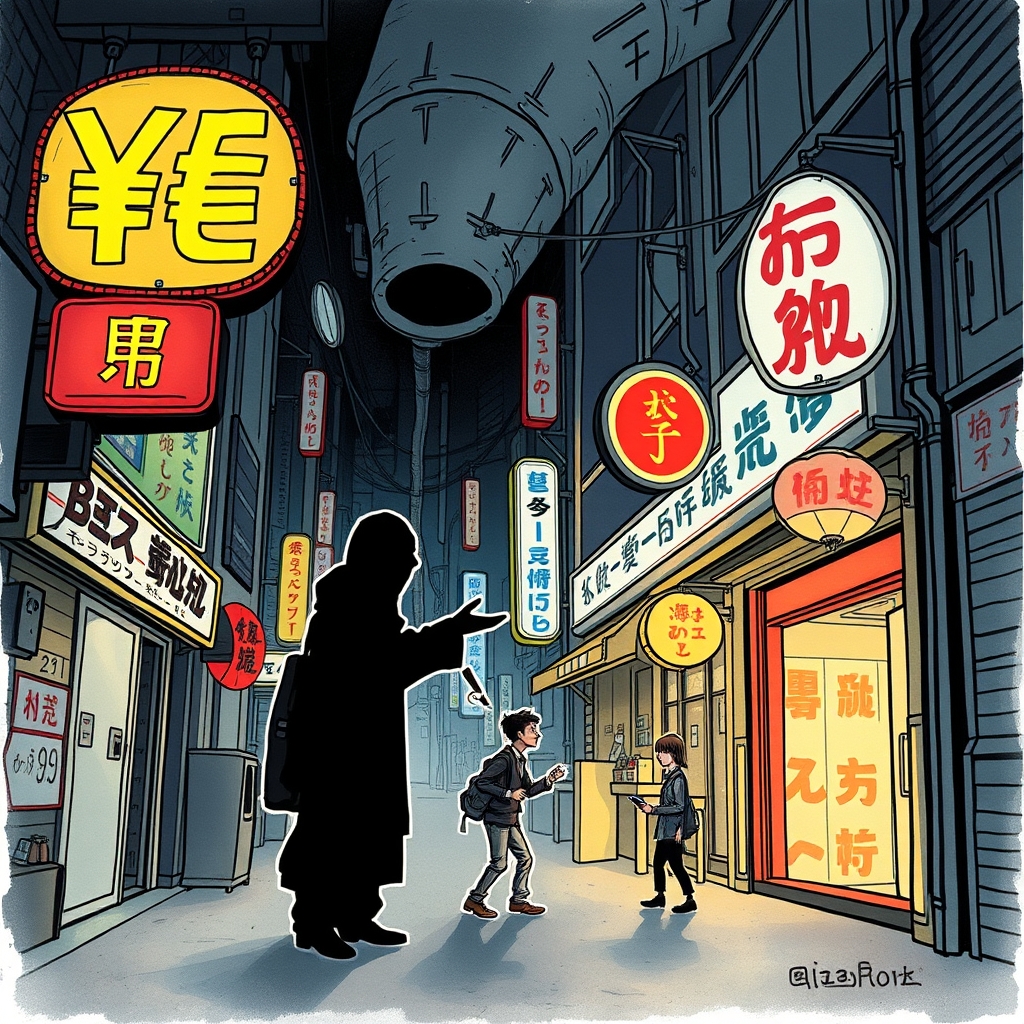
A Grab on the Sidewalk
The pitch, according to Tokyo police, came with a smile and a grip on the wrist: "Don't be scared. I love you."
In the small hours of July 9, 2026, officers in Shinjuku's Kabukicho district arrested a 53-year-old Nigerian man, a resident of Tokyo's Suginami Ward with no listed occupation, on suspicion of violating the Tokyo Metropolitan Nuisance Prevention Ordinance (meiwaku boshi jorei, the local statute that bans persistent street solicitation). Police say he grabbed passersby by the hand and pressed them to follow him to a venue, refusing to let go as he worked the street around 1:35 a.m.
The arrest, reported by Kyodo News and NHK, is a single case built from a single night on one Kabukicho block. Police, however, are presenting it as one strand of a much larger problem: an organized network of foreign touts that has turned Japan's densest nightlife quarter into a hazard for the tourists now flooding back to it.
The account so far is the authorities'. Police have not disclosed whether the man admits or denies the allegation, and no charge has been tested in court. As with any arrest, the suspect has not been convicted.
What the Touts Are Selling
The tout—kyakuhiki in Japanese—is a fixture of Kabukicho's economy, and a persistently illegal one. Under Tokyo's nuisance ordinance and the country's entertainment-business rules, aggressively flagging down strangers on the street to steer them into bars, clubs, and adult-entertainment venues is prohibited. Enforcement has long been uneven enough that the practice reads, to a first-time visitor, like part of the scenery.
What waits at the end of the walk is often a bottakuri bar—a rip-off joint where a drink that sounded cheap on the sidewalk becomes a bill in the tens or hundreds of thousands of yen, sometimes enforced by staff who make clear that leaving without paying is not an option. The tout is the funnel; the overcharge is the business model.
That is the machinery police say this arrest is meant to disrupt. According to the figures cited by investigators, Shinjuku's Metropolitan Police fielded 91 complaints between January and June 2026 involving touts described as foreign nationals who led customers to restaurants and bars that then charged exorbitant sums. The reported losses across those complaints total roughly 99 million yen. Police say a special investigative unit is examining how the arrested man fits into a foreign tout ring working the district at night, and they have issued an unusually direct warning to overseas visitors to ignore street solicitation altogether.
A Piece of the Kabukicho Purge
The arrest lands inside a campaign that has run hard through 2026. Over the past year, the Metropolitan Police have moved to "clean" Kabukicho on several fronts at once—installing cameras, tightening ordinances, and pushing against the touts and scouts who feed the district's grey economy. That same push has reached deep into the sex trade itself: a wave of soapland raids under the Anti-Prostitution Act (baishun boshi-ho), arrests of scout operators who funnel women into paid sex work, and, in early July, the round-up of dozens of people accused of street prostitution in the same neighborhood.
Touting sits at the front door of that ecosystem. The men working the sidewalks are not, in most cases, the operators of the venues they steer customers toward; they are the visible, replaceable edge of a chain that runs back through bars, clubs, and the networks that staff them. Arresting one tout does not close a bottakuri bar. But it is the kind of case that lets police put a number—91 complaints, 99 million yen—on a nuisance that visitors experience one wrist-grab at a time.
The foreign dimension has drawn its own scrutiny. Kabukicho's night-time solicitation has, for years, been associated in the Japanese press with West African tout crews, and police framing of this arrest around a "foreign tout ring" fits a broader official narrative about organized street solicitation in the district. It is worth stating plainly what the record does and does not show: one man has been arrested on one ordinance violation, and the wider ring remains, by the police's own account, under investigation rather than proven.
The Visitor's-Eye View
For the tourist walking east from Shinjuku Station after midnight, none of the enforcement architecture is visible. What is visible is a man stepping into the path, taking a hand, and offering reassurance in broken English. The reassurance—"don't be scared"—is precisely the tell.
Whether this particular case holds will be settled in the ordinary course of investigation and any prosecution that follows. What the arrest signals is narrower and clearer: that Tokyo police, a year into a very public effort to make Kabukicho less predatory, are now willing to book a street tout by name and hang a nine-figure damage figure on the trade he represents.
This article is compiled from reporting by Kyodo News (via Yahoo! News Japan) and NHK. Facts are attributed to those reports. The suspect's name has been withheld here given inconsistent transliteration across sources and the early, unproven stage of the case; his nationality, age and residence are given as reported by police. Complaint counts and the roughly 99-million-yen damage figure are the authorities' figures for January–June 2026. Points that remain unconfirmed are noted as such.