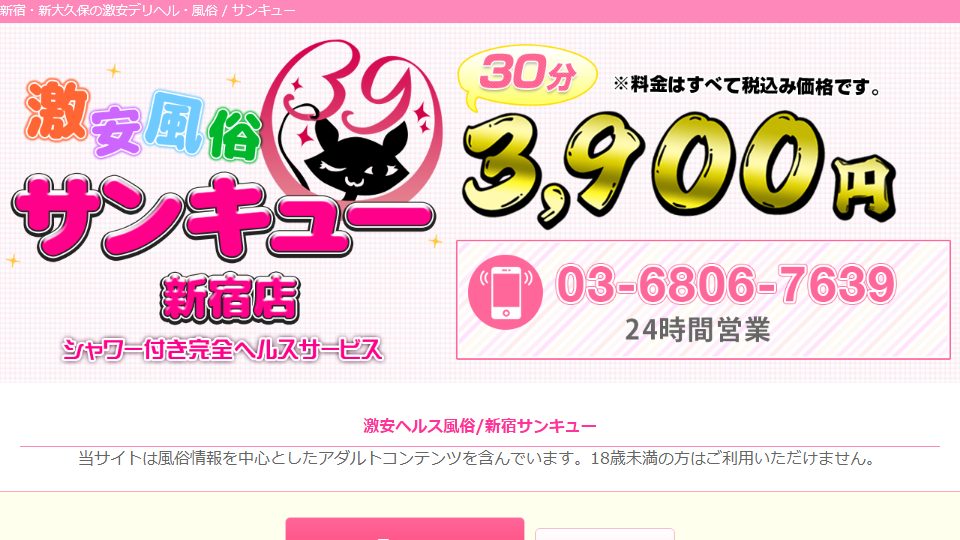

Let me be precise about what Shinjuku Thank You (新宿サンキュー / Shinjuku Sankyū) is, because the whole thing runs on one number and most people misread it. It's a delivery health — a deriheru — operating out of Shinjuku-Kabukicho, part of a nationwide "Thank You" chain, and it markets itself with a single, relentless claim: industry's lowest price (業界最安値). The anchor is a ¥3,900 base rate for 30 minutes, day or night, identical around the clock. It doesn't have a storefront you visit. It has a phone line, an online booking form, and a dispatch grid that sends a girl to your hotel, love hotel, or residence anywhere in Tokyo. The genre is ordinary. The pricing is the entire strategy.
The ¥3,900 Is a Door, Not a Price
Look at the base rate the way an operator would, not a bargain hunter. ¥3,900 for 30 minutes, held flat day and night, 24 hours a year-round. No shop actually makes its living on that number, and it isn't supposed to. That figure exists to do one job: remove the decision. A man in a Kabukicho hotel at 3 AM doesn't have to weigh whether tonight is worth it — at ¥3,900 the answer is reflexive, and reflex is exactly what a budget shop is buying. The base rate is a loss-leader in spirit if not in accounting: it converts hesitation into a phone call. Everything that matters to the shop's margin — the designation fee, the longer courses, the promotional packages — happens after the customer has already said yes. That's not a trick. It's the cleanest customer-acquisition funnel in the business, and the ¥3,900 is the top of it.
Reading the Real Ladder
The headline is the bait; the ladder is the meal. Here's what the shop actually states. The designation fee (shimei) is ¥2,000. Courses over 60 minutes carry a ¥1,000 discount. And the promotional packages run a wide band — roughly ¥8,000 up to ¥29,800 depending on length and options. Read that spread instead of the ¥3,900, because the spread is who they're really selling to. The short base course removes the flinch. The mid-tier packages in the teens are where a normal customer actually lands once they've added the designation and stretched past the 30-minute floor. And the ¥29,800 ceiling is the shop quietly telling you it can serve a serious buyer too, not just the walk-up bargain. The over-60-minute discount is the tell: like every well-run time business, it pays you to commit longer, because a longer booking is a more efficient use of a girl's dispatch window than two short ones with travel in between.
The 50 Free Options Are the Unbundle
Here's the line that separates this from a plain cheap deriheru: the shop advertises over 50 options, offered complimentary with the designation fee. Think about what that actually does. A normal budget shop nickel-and-dimes you — every add-on is a separate charge, and the "cheap" base quietly balloons into something that isn't cheap at all. Shinjuku Thank You does the opposite: it bundles the extras into the shimei so the price you hear is close to the price you pay. That's a deliberate anti-surprise strategy. In a category where the entire reputational risk is "the ad said cheap and the bill said otherwise," pre-loading fifty options into one flat designation fee is how a budget brand buys trust it can't afford to advertise. It's the same instinct as an all-inclusive fare: the value isn't only the price, it's the absence of a second, worse number waiting at the end.
Logistics Are the Silent Product
Under the pricing, this is a logistics company that happens to sell intimacy. The hours are the proof: 24 hours, year-round, no closing. That's not a small shop coasting — that's a dispatch grid deliberately built to catch demand at the exact hours Kabukicho generates it, which is to say all of them. The value of "never closed" is invisible until you need it. A man decides, alone, at 4 AM, that tonight is the night; a shop that answers at 4 AM captures a customer that a 10-to-late operation simply forfeits. Running a true around-the-clock window across Tokyo costs real money in staffing and coordination, and a budget brand spending it anyway is telling you where it actually competes: not on romance, on availability. The girl is the product on the surface. The thing that makes the model work is that she can be at a Shinjuku door at any hour the city is awake — which is every hour.
The Verdict on the Value
- Price honesty: ★★★★☆ — the ¥3,900 base is real and held flat day and night; the ¥2,000 shimei and the ¥8,000–¥29,800 package band are stated plainly, so the ladder is legible even if the headline is bait.
- Anti-surprise: ★★★★★ — bundling 50-plus options into the designation fee is the smartest thing on the menu; it kills the "cheap ad, expensive bill" trap that sinks most gekiyasu shops.
- Availability: ★★★★★ — genuine 24-hour, year-round dispatch across Tokyo is infrastructure, not a slogan, and it's the real reason to keep this number saved.
- Concept clarity: ★★★☆☆ — this is a budget deriheru, full stop; it competes on price and availability, not theme or fantasy, and it doesn't pretend otherwise.
- Going back: ○ — for a fast, low-friction, any-hour booking in central Shinjuku, the flat rate plus bundled options is a rational buy; it's the number you call when you want the decision to be easy.
I came to Shinjuku Thank You expecting the usual budget bait — a ¥3,900 sign hiding a bill three times its size — and left convinced the low number is a strategy, not a lie. The base rate is a door priced below the flinch line; the ¥2,000 designation fee is where the model prices real intent; the 50-plus bundled options are a deliberate move to kill the second, worse number that sinks every other cheap shop; and the 24-hour Tokyo-wide dispatch is the quiet infrastructure that makes the whole thing worth saving in your phone. This isn't the shop for a man chasing a specific fantasy or a curated scene — it doesn't sell that, and it won't pretend to. It's the shop for the man who wants the fewest reasons to say no at the hour when saying no is easiest. Value logged, and the funnel logic holds.