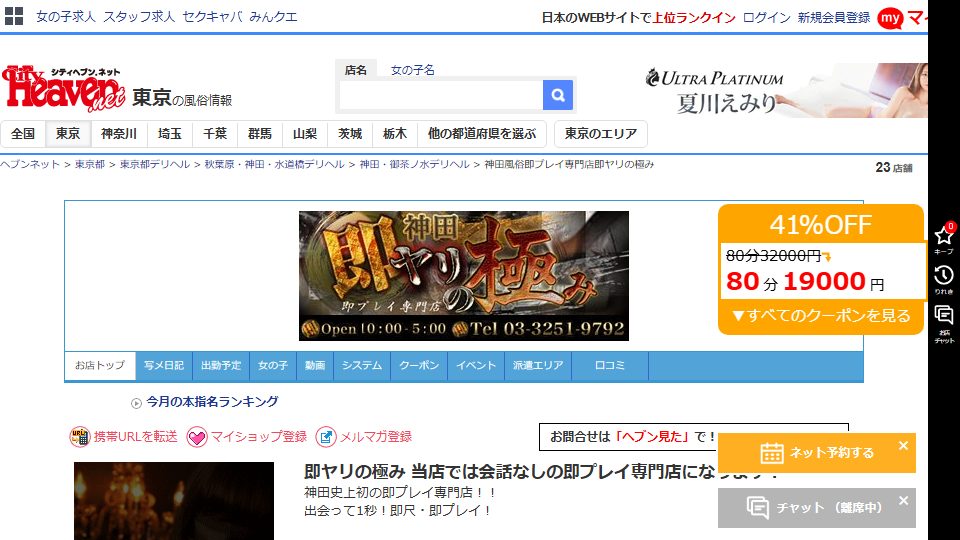

Let me tell you exactly what 即ヤリの極み — Soku Yari no Kiwami, roughly "The Pinnacle of Immediate Play" — is, because the genre it belongs to is one English speakers almost never hear named, and it's worth naming precisely. It's a デリヘル, a delivery health, a deriheru — no storefront, she comes to a rented room or your hotel — working the Kanda / Akihabara / Ochanomizu / Suidobashi corner of Chiyoda Ward, the student-and-office quarter northeast of the Imperial Palace. And it's a 即プレイ専門店 — a "soku-play specialty shop." Soku means immediate. The concept, stated flat on the page, is play without the conversation — no icebreaker, no warm-up chatter, no getting-to-know-you. I booked it to find out what a shop actually delivers when the thing it removes is the small talk.
"Soku" Is Not About Speed. It's About the Thing It Deletes.
The easy misread is that "immediate play" means fast — a rushed forty minutes for the man in a hurry. That's wrong, and the mistake matters. The clock here is identical to a normal shop's — forty, sixty, eighty, a hundred, a hundred and twenty minutes. You don't get less time. What you lose is the preamble: the five-to-ten-minute social airlock at the front of every ordinary session where two strangers pretend to be at ease with each other before anything happens. Soku-play amputates that. She arrives, and the encounter begins — no throat-clearing, no manufactured rapport. So the product isn't a shorter hour. It's the same hour with the awkward part surgically removed. For the man who books this, the small talk was never the appetizer. It was the tax.
The Genre Exists for One Specific Customer
You have to understand who this is built for, because the answer explains the whole business. The standard deriheru is optimized for a man who wants the intimacy theater — the illusion, however thin, that this is closer to a date than a transaction. Soku-play is optimized for his opposite number: the man for whom the pretense of connection is more tiring than the act itself. Maybe he's shy and the forced chit-chat is agony. Maybe he's a regular who's done the pantomime a hundred times and is bored of it. Maybe he just finds the fake-girlfriend script more dishonest than the honest thing underneath it. Whatever the reason, this shop's entire proposition is: we will not make you perform. That's a genuinely different product, and naming your shop after it is a form of honesty most of the industry won't risk.
The Price Card Tells You It's a Normal Shop Underneath
Here's the reassuring part: strip away the concept and the numbers are ordinary, which is a good sign, not a boring one. The ladder runs 40 minutes ¥12,000, 60 for ¥17,000, 80 for ¥22,000, 100 for ¥28,000, 120 for ¥34,000, with a 30-minute extension at ¥10,000 and a ¥2,000 designation fee. From the 80-minute course up, a vibrator/massager is included — a tell that the longer bookings are expected to go somewhere more elaborate than the 40-minute "just the point" session. This is mid-market, mainstream pricing — not a budget shop, not high-class. The lesson is that soku-play is a format, not a price tier: you're paying the normal rate for a normal-length session, and the "immediate" part is a free structural feature, not a premium you're charged for. A gimmick shop would tax you for the concept. This one just runs it.
Free Transport, Paid Room — Read the Logistics
The delivery math is worth reading closely because it tells you how to book. Transport is free, but the rented room costs ¥1,000 near Kanda Station and ¥2,000 near Tokyo Station — the inverse of many shops, which nickel-and-dime the travel and stay quiet about the bed. Here the shop eats the transport and the room is your line item, which means the cheap play is to book a hotel yourself or stay in the Kanda-cheap zone rather than the Tokyo-Station-pricey one. The delivery net covers Chiyoda, Chuo, Minato, Bunkyo, Shinjuku, Sumida, Koto and Taito — a genuinely wide central-Tokyo footprint, so this reads as a citywide-central shop wearing a Kanda address, not a neighborhood-only operation. And the clock is long: 10:00 AM to 5:00 AM, no days off — a nineteen-hour door that catches the Akihabara day-tripper and the last-train straggler alike.
The Caveat, Sharpened by the Concept
The standard roster warning applies with a specific twist here. Because the model deletes the warm-up, there's no social buffer to rescue a bad match — in a normal shop the chatter gives both of you a few minutes to adjust; soku-play removes that runway entirely, so the fit between you and the woman on the roster tonight matters more, not less. Book the shop for its honest, no-theater format, but the nomination is doing real work — the ¥2,000 designation fee is cheap insurance for a model that offers no other place to recover if the pairing is off. "The shop does immediate play well" and "tonight's woman does immediate play well" are, as always, two different sentences — and this concept leaves less room than most to paper over the gap.
The Verdict on Cutting the Preamble
- Concept honesty: ★★★★★ — the shop is named after its actual product and the product is real: not speed, but the surgical removal of the small-talk tax. Few places name what they sell this bluntly.
- Who it's for: ★★★★☆ — purpose-built for the man who finds the intimacy pantomime more tiring than the act; exactly wrong for the man who wants the girlfriend theater, and honest enough that both can tell instantly.
- Price honesty: ★★★★☆ — ordinary mid-market rates for ordinary-length sessions; the "immediate" format is a free structural feature, not a gimmick surcharge, which is the right way to price a concept.
- Access / hours: ★★★★☆ — a nineteen-hour clock and a wide central-Tokyo delivery net; free transport with the room as your line item rewards booking smart near Kanda rather than Tokyo Station.
- Going back: ○ — for the regular who's tired of performing rapport, the second visit is easier than the first, because the whole appeal is that there's no relationship to rebuild each time.
I booked Soku Yari no Kiwami to find out what's left when a shop deletes the conversation, and the honest verdict is that what's left is the honest part. This is a mid-market Kanda deriheru whose entire concept is the removal of the warm-up — same clock as anywhere, ordinary prices, wide central-Tokyo delivery, built expressly for the man who experiences the fake-girlfriend script as work rather than pleasure. It is emphatically not the shop for the man who wants to be courted; that man will find the missing preamble cold. But for his opposite — the shy, the bored-of-the-act, the man who finds the pretense more dishonest than the thing it dresses up — the deletion isn't a loss. It's the feature he was calling for. First set logged, and the product here isn't the sex. It's the silence where the small talk used to be.