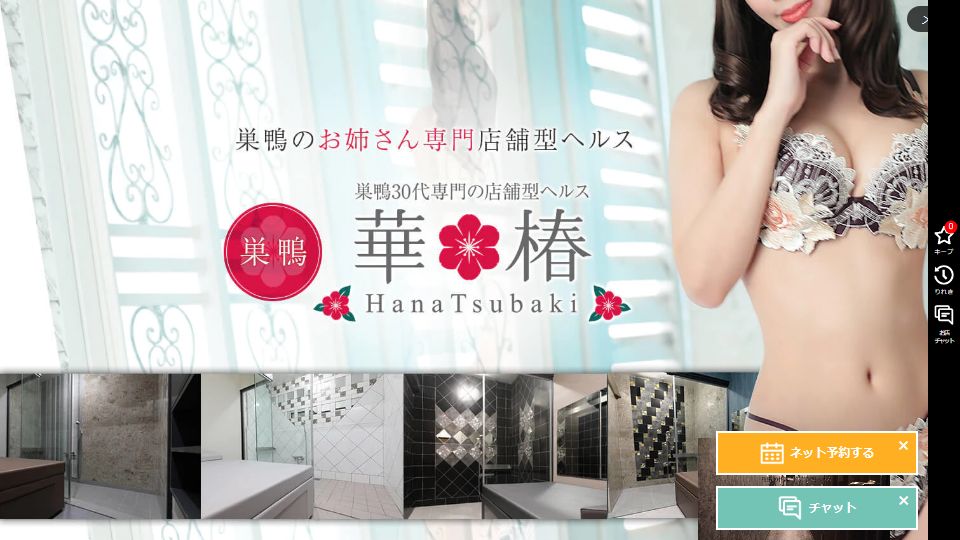

Let me be precise about what Hanatsubaki is before the sleepy Sugamo address makes you file it wrong. It's a 店舗型ヘルス — a store-type health shop, a hako-heru — meaning you go to their room, not a hotel, one minute on foot from Sugamo Station on the Yamanote Line, deep in Toshima Ward's quietest corner. Not a soap. Not a delivery outfit that ferries a girl to your door. A fixed address, a reception desk, a room. And two facts on the door that most people skim past: it opens at 6 in the morning, and it sells women in their thirties on purpose. I came at dawn specifically to see whether those two lines were marketing filler or an actual strategy. They're a strategy.
The Dawn Slot Is the Whole Product
Walk Sugamo at 6 a.m. and the famous Jizo-dori "old-lady Harajuku" is still shuttered, the Yamanote is running near-empty, and every flashy shop in Ikebukuro five minutes south is dark and locked. Hanatsubaki's light is on. That's not an accident of scheduling — that's the entire competitive thesis. Think about who is actually awake and looking at this hour: the guy coming off a night shift, the man who couldn't sleep, the traveler with a 9 a.m. meeting and three dead hours, the local who wants his day handled before the city wakes up. None of those people are being served by a market that all clocks in at 8 p.m. The premium hours are a bloodbath of undercutting; the dawn hour is empty shelf space. By opening at six, Hanatsubaki isn't offering a worse version of the night — it's the only offer in a window with real demand and no supply. That's the highest-margin position a small shop can hold: being the only one open.
The Thirties Bet
Here's the second call, and it's the one that separates operators who think from operators who copy. Hanatsubaki brands itself an "adult lady specialist" — 大人の女性、女性の年齢層は30代中心, a roster built deliberately around women in their thirties. The lazy industry reflex is to chase the youngest possible cast, because "younger" is the default lever every shop pulls. But when everyone pulls the same lever, the youngest-cast market is saturated and brutal, and a woman in her early twenties has fifty flashier doors competing for her. Specializing in thirties is a counter-position: less contested supply, and a genuinely different product. A woman in her thirties reads the room, sets the pace, doesn't need the clock to warm her up. For a large slice of customers — especially the ones awake at 6 a.m., who are not nineteen either — that's not the consolation product. That's the preferred product. Hanatsubaki figured out that the underserved buyer and the underserved worker were the same demographic gap, and built one shop to close both.
The Location Moat
Don't skip the address as scenery — it's part of the math. Sugamo is the anti-Kabukicho: low rent, low flash, a resident base that skews older and stays put. For a flashy nightlife brand that's a liability. For a low-key, regular-driven health shop it's a moat. Cheap fixed costs mean the shop can survive on a thinner, steadier stream of repeat locals instead of chasing expensive one-time walk-ins, and the lack of glitter next door means no bigger operator wants the corner. One-minute access to a Yamanote platform gives it citywide reach without paying Ikebukuro prices for the storefront. That's the quiet version of a durable business: low burn, loyal base, a location too unglamorous for anyone bigger to bother contesting.
The Pricing, Straight
No fog here. Hanatsubaki runs 30-, 45-, and 60-minute courses, with a new-customer rate seen around ¥9,000 for 30 minutes and a standard ¥10,000 for 30 minutes, hours running 6:00 a.m. to midnight, year-round, no days off. Read that as a mid-market, no-nonsense floor — not a bargain-bin impulse price, not a luxury tier either. You're paying a fair-market number for two things the number doesn't obviously reveal: a room that's actually open when nothing else is, and a cast chosen for composure over novelty. Whether that's worth it depends entirely on whether you value those two, but the price itself isn't playing games.
The Verdict on the Dawn Shift
- Concept clarity: ★★★★☆ — a dawn-open, thirties-focused hako-heru that knows exactly which two gaps it's filling and doesn't pretend to be anything else.
- Timing edge: ★★★★★ — the 6 a.m. open is unmatched inventory; at that hour it's not the best door, it's the only one.
- Roster fit: ★★★★☆ — a deliberate thirties specialization that's the preferred product for its buyer, not a fallback.
- Price honesty: ★★★★☆ — ¥9,000–¥10,000 for 30 minutes, a clean mid-market floor with no upsell theater.
- Going back: ○ — if your useful hours are the ones the rest of the city sleeps through, this is a rare shop built for exactly that.
I came to Sugamo at dawn half-expecting the "6 a.m." and "thirties specialist" lines to be filler dressed up as features. Wrong read on both. The early open isn't a quirk — it's the shop selling an hour every competitor leaves on the table. The age niche isn't a limitation — it's a counter-position that turns "who's left" into "who I actually wanted." Wrapped around cheap Sugamo rent and a Yamanote platform one minute away, that's not a sleepy neighborhood health shop coasting on locals. It's a small operator making the exact three calls a small operator should: be the only one open, own the segment the giants ignore, and keep the burn low enough to outlast them all. Sun wasn't even up when I walked out, and the whole city still hadn't gotten around to competing.